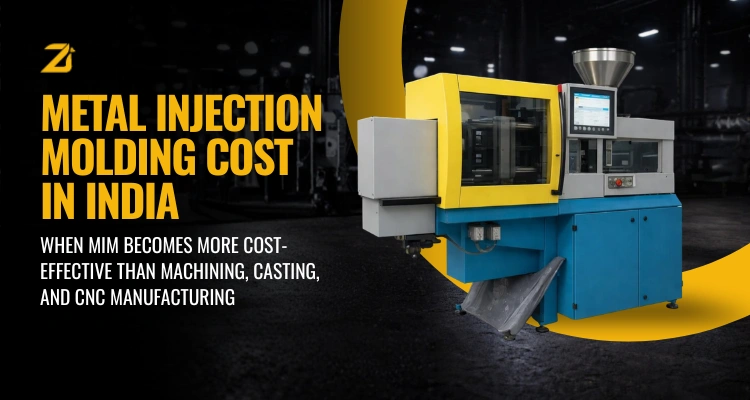
Metal Injection Molding Cost in India: When MIM Becomes More Cost-Effective Than Machining, Casting, and CNC Manufacturing
 Digvijaysingh Rao
on
Digvijaysingh Rao
on
Introduction
Metal Injection Molding presents a capital investment trade-off that procurement teams regularly misread. Tooling investment is significant upfront, but per-part cost drops sharply as production volume increases, often making MIM the most economical precision metal manufacturing process at scale.
For Indian manufacturers, this decision carries specific weight. Labor cost structures, raw material availability, domestic tooling ecosystem maturity, and export pricing pressure all determine whether MIM delivers a positive return. Adopting MIM at the wrong volume threshold destroys margin instead of protecting it.
Understanding MIM cost economics is not a routine procurement function. It is a strategic manufacturing decision that requires simultaneous inputs from engineering, finance, and production planning teams.
Key Takeaways
- MIM carries a high tooling cost but delivers significantly lower per-part cost at production scale
- Break-even versus CNC machining depends on part geometry complexity and annual production volume
- MIM eliminates or reduces most secondary machining operations, compressing total production cost
- The process enables mass production of complex metal parts that are prohibitively expensive to machine individually
- Strong ROI is achievable in high-volume precision manufacturing across automotive, medical, defense, and electronics sectors
MIM Tooling Cost in India and What It Includes
Tooling is the largest single cost variable in the MIM adoption decision. Investment scales with part complexity, mold cavity count, and the material selected for the mold body. Single-cavity tooling for a moderately complex part and multi-cavity tooling for high-volume production represent substantially different upfront commitments, and both must be evaluated against total production volume before any cost comparison is meaningful.
The tooling investment covers several components: mold design and engineering, H13 tool steel machining for the mold body, cavity finishing and polishing, sprue and runner system design, ejection mechanism fabrication, and initial trial and validation runs. Each of these contributes to the total tooling figure and must be accounted for in full.
Amortization logic is critical here. A well-maintained MIM mold has a service life of 500,000 to 1,000,000 shots. At high annual production volumes, the tooling cost contribution per part becomes negligible. At low volumes, that same tooling investment remains a dominant cost burden. The amortized tooling cost per part, not the upfront figure, is the only meaningful basis for process comparison.
MIM Cost Per Part Breakdown (Material, Processing, Sintering, Finishing)
MIM per-part cost has five primary components: feedstock material cost, injection molding cost, debinding cost, sintering cost, and finishing or secondary operations cost.
- Feedstock Cost: MIM feedstock consists of fine metal powder combined with a thermoplastic or wax-based binder system. Material utilization in MIM exceeds 95% for optimized processes. This compares favorably against CNC machining, where 40% to 70% of input material is often discarded as swarf, adding raw material waste to the per-part cost structure.
- Processing and Sintering Cost: Injection molding, debinding, and sintering are energy and equipment-intensive operations. Sintering furnace utilization is the primary cost lever. Higher furnace loading per cycle directly reduces the sintering cost contribution per part. Facilities with strong production scheduling discipline carry a structural cost advantage here.
- Finishing and Post-Processing: Parts requiring tolerances tighter than MIM's natural achievable range of plus or minus 0.3% to 0.5% of dimension will need CNC finishing as a secondary operation. Surface treatment, heat treatment, electroplating, or PVD coating are additional cost line items that must be modeled from the start.
As production volume increases, per-part cost decreases significantly. The step reduction between medium and high production volumes is where MIM economics become commercially decisive.
When is MIM Cheaper Than CNC Machining? Break-Even Analysis
The break-even point between MIM and CNC machining is governed by two factors: part geometry complexity and annual production volume. For simple geometries with low feature density, CNC machining retains its cost advantage up to 20,000 to 50,000 parts annually. For complex geometries with internal features, undercuts, thin walls, or cross-holes, MIM reaches cost parity with CNC machining at 5,000 to 10,000 parts per year.
The geometric complexity factor is significant. As CNC tool path complexity increases, cycle time, tool wear, and scrap rate all rise together. MIM's injection-based process is largely indifferent to internal geometry complexity. The more complex the part, the lower the volume threshold at which MIM becomes the more economical process.
The break-even calculation for procurement teams is direct: divide total MIM tooling investment by the per-part cost differential between CNC machining and MIM. The result is the break-even production quantity. Every part produced beyond that quantity represents net cost reduction relative to the CNC alternative.
MIM vs Casting vs Forging vs CNC Cost Comparison in India
| Process | MIM | Die Casting | Investment Casting | CNC Machining | Forging |
| Tooling Investment | Moderate to High | Moderate | Low to Moderate | Minimal | High |
| Per-Part Cost at Volume | Low | Low | Low to Moderate | High for Complex Parts | Moderate |
| Material Utilization | 95%+ | 80% to 90% | 85% to 95% | 30% to 60% | 85% to 95% |
| Secondary Operations | Minimal | Moderate | Moderate to High | Low | High |
The comparison must go beyond per-part cost to include lifecycle cost: scrap rate, secondary operation cost, tolerance compliance rate, and rejection-related losses across the full production run.
Die casting delivers low per-part cost but is restricted to non-ferrous alloys and achieves lower density than MIM. Investment casting handles ferrous alloys but requires significant post-casting machining for precision features. Forging produces excellent mechanical properties but cannot produce internal features without subsequent machining, which inflates total cost significantly for complex geometries.
MIM's structural advantage is geometric freedom combined with sintered density exceeding 95% of wrought metal equivalent. For precision components where internal geometry determines function, MIM eliminates 60% to 80% of secondary machining cost compared to casting or forging alternatives at comparable production volumes.
Volume Economics: Low, Medium, and High Production Scenarios
Low Volume (Under 5,000 Parts Per Year)
MIM is rarely the correct economic choice at this scale. Tooling investment does not amortize efficiently at low volumes, and the per-part cost advantage over CNC machining or investment casting is insufficient to offset the initial tooling outlay within a reasonable timeframe.
The only exception applies when part geometry is too complex for any alternative process to produce within tolerance. In that case, MIM may be the sole viable manufacturing route regardless of volume economics.
Medium Volume (5,000 to 50,000 Parts Per Year)
This is the transition zone where MIM competitiveness depends heavily on geometry complexity and tolerance requirements. Complex parts with high CNC machining cost will reach break-even with MIM tooling investment within 6 to 18 months of production. Simple geometries with relatively low machining cost may not reach break-even within a standard product lifecycle.
Procurement teams evaluating MIM in this volume range should request a formal break-even and tooling ROI analysis before committing to tooling investment.
High Volume (50,000 to 500,000+ Parts Per Year)
This is MIM's strongest economic territory. Tooling amortization becomes negligible in total unit economics. Annual material savings compared to CNC machining can recover the tooling investment independently within 12 months for medium-weight components in optimized processes.
For OEMs committing to multi-year supply agreements, MIM at high volume delivers the lowest lifecycle cost of any precision metal manufacturing process for small, complex components in the 1 to 50 gram weight range.
Industry Use Cases Where MIM Delivers Maximum Cost Advantage
- Automotive: Sensor housings, locking mechanism components, fuel injector bodies, and small transmission parts in stainless steel or low alloy steel. At volumes exceeding 100,000 parts annually, MIM per-part cost is 50% to 70% lower than CNC machining equivalents for geometrically complex components. Explore Zealot's industries served page for automotive-specific MIM applications.
- Medical and Surgical Instruments: Laparoscopic tool components, surgical scissors, orthodontic brackets, and endoscope bodies require tight tolerances, biocompatible materials, and surface finish compliance. MIM in 316L or 17-4 PH stainless steel delivers all three requirements at mass production cost levels that conventional machining cannot match economically.
- Defense and Aerospace: Trigger mechanism components, sight mounts, connector bodies, and precision fasteners in titanium alloys or M2 tool steel benefit from MIM's material density and dimensional consistency across production batches. At mid-to-high volumes, MIM cost per part in these alloys is substantially lower than alternative manufacturing routes.
- Electronics and Industrial Hardware: Small connector components, electromagnetic shielding parts, and precision fasteners at high annual quantities represent textbook MIM applications. Volume-sensitive cost reductions are most dramatic in this category, where annual production quantities routinely exceed the critical volume threshold.
India Manufacturing Advantage in MIM Cost Structure
India offers a structural cost advantage in MIM manufacturing that global procurement teams are increasingly recognizing. Skilled tooling and mold-making labor in Gujarat, Maharashtra, and Tamil Nadu operates at 30% to 50% of the cost of equivalent Chinese facilities and at 15% to 25% of European or US equivalents. This labor cost differential directly reduces both tooling investment and per-part processing cost for components manufactured in India.
Sintering furnace infrastructure, powder metallurgy supply chains, and precision metrology capabilities have matured significantly in India over the past decade. Indian MIM manufacturers can access feedstock from domestic and international sources, with cost flexibility depending on alloy grade and volume requirements.
For export-oriented OEMs procuring MIM components from India, the combination of lower tooling cost, lower per-part processing cost, and competitive logistics positions Indian MIM suppliers favorably against Southeast Asian and Chinese alternatives on total landed cost.
Conclusion
MIM becomes economically superior to CNC machining, forging, and investment casting when production volumes exceed 5,000 to 10,000 parts annually for complex geometries, or 20,000 to 50,000 parts annually for moderate complexity components.
The evaluation framework is direct: calculate total tooling investment, determine the per-part cost advantage over the alternative process, and divide tooling investment by per-part savings to identify the break-even production quantity. For any volume commitment beyond that threshold, MIM is the most cost-efficient precision metal manufacturing route.
The critical error procurement teams make is treating tooling cost as a single-period expense. It is a capital investment that amortizes across total production volume. At sufficient scale, tooling cost contribution per part becomes negligible, and MIM's material utilization efficiency, elimination of secondary machining operations, and per-part cost discipline become the dominant economic factors.
India's labor cost structure, tooling ecosystem, and sintering infrastructure make the MIM economics case stronger for domestic production and export supply chains than at any previous point in the industry's development.
Frequently Asked Questions (FAQs)
Read More:
- What Parts Can Be Made with Metal Injection Molding (MIM)? Across 8 Key Industries
- Metal Injection Molding (MIM) Design Guidelines: Complete DFM Guide
- The MIM Process Step by Step: From Metal Powder to Precision Component
- Is MIM Right for Your Part? The Complete Decision Framework for Indian Manufacturers
- MIM vs CNC Machining: When Metal Injection Molding Wins on Cost, Complexity & Volume

Digvijaysingh Rao
Head of Sales & Strategy
Digvijaysingh Rao leads sales and business development at Zealot Inc. He works closely with customers to understand their production challenges and recommend solutions that are practical and easy to maintain.