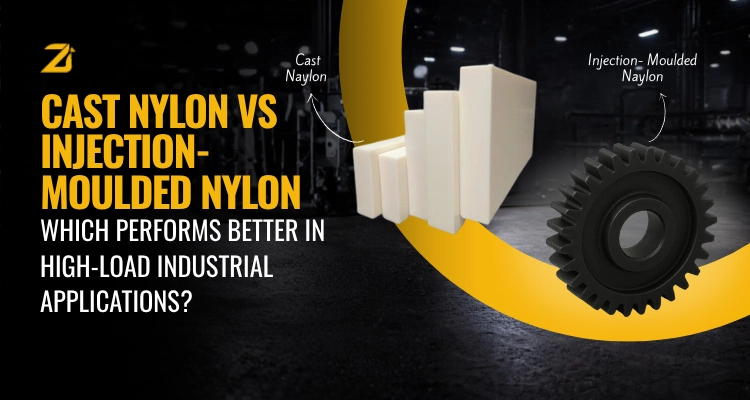
Cast Nylon vs Injection-Moulded Nylon: Which Performs Better in High-Load Industrial Applications?
 Digvijaysingh Rao
on
Digvijaysingh Rao
on
Introduction
Evaluating engineering plastics for heavy-duty machinery requires looking past basic material family names. When comparing cast nylon vs injection-moulded nylon, both belong to the polyamide group, but their manufacturing processes dictate vastly different molecular structures and factory-floor performance. Cast nylon achieves a significantly higher molecular weight, translating directly to superior wear resistance, higher tensile strength, and exceptional load-bearing stability compared to standard injection moulding.
Selecting standard injection-moulded components for continuous-wear environments often leads to premature part failure and costly downtime. Since 1996, Zealot Inc. has specialized in precision polymer processing, building state-of-the-art, fully automatic machines designed specifically for nylon casting. As Indian industries scale toward heavier outputs, our advanced casting systems empower manufacturers to consistently produce high-molecular-weight components capable of replacing heavy metal gears, bearings, and slides.
Key Takeaways
- Cast Nylon (MC Nylon) is produced through the anionic polymerization of caprolactam directly within a mold.
- The casting process yields an average molecular weight exceeding 100,000, compared to 20,000-30,000 for injection-moulded nylon.
- Cast nylon delivers exceptional wear resistance that measures up to 10 times higher than standard injection-moulded PA6.
- Tensile strength for cast nylon reaches 70-100 MPa, allowing it to approach the performance characteristics of aluminum in specific structural applications.
- Injection moulding remains the superior choice for high-volume, thin-walled, or micro-components requiring zero post-production machining.
- Evaluating materials based on Total Cost of Ownership (TCO) proves that cast nylon minimizes lifecycle costs through extended replacement intervals.
- The precision of the casting machinery directly controls reaction stability, determining the structural integrity of the final polymer.
Two Ways to Make Nylon - and Why It Changes Everything
To understand why cast polyamide vs extrusion nylon or injection-moulded nylon behave differently under load, engineers must examine polymer chain formation. The thermal and chemical histories of these materials dictate their ultimate crystalline structures.
The Injection Moulding Process
Injection moulding relies on pre-polymerized nylon pellets. These pellets are fed into a heated barrel, mechanically sheared by a rotating screw until molten, and injected under immense pressure into a cooled metal mold.
Because the polymer chains are already formed before entering the machine, the melting and shearing process places significant thermal and mechanical stress on the material. Furthermore, rapid cooling inside the mold limits the time available for the polymer chains to organize into highly ordered crystalline structures. This leaves the finished component with elevated internal stresses and a lower degree of crystallinity.
The Cast Nylon (MC Nylon) Process
Monomer Cast Nylon (MC Nylon) bypasses the pellet melting stage entirely. Instead, it is produced through the direct anionic polymerization of liquid caprolactam inside the mold cavity itself.
The chemical mixture, combined with specific catalysts and activators, is introduced into a pre-heated mold at atmospheric pressure. The polymerization reaction occurs in situ, allowing polymer chains to grow naturally without the destructive mechanical shearing found in extrusion or injection screws. Because the material cures slowly under controlled thermal conditions, the polymer chains achieve a highly ordered, stress-free crystalline formation.
Molecular Weight: Why Cast Nylon's 100,000+ Matters vs Injection Moulding's 20,000-30,000
In polymer engineering, molecular weight serves as the primary indicator of physical performance. Molecular weight reflects the length of the individual polymer chains within the material matrix; longer chains entangle more thoroughly, creating a denser, more resilient structure.
Standard injection-moulded nylon typically achieves a molecular weight ranging between 20,000 and 30,000. The chains are relatively short, which limits their ability to distribute heavy localized mechanical loads across the broader polymer matrix.
By contrast, the anionic polymerization process used to create cast nylon yields an impressive molecular weight exceeding 100,000. This massive differential unlocks standard-defining MC nylon superior properties across several mechanical vectors:
- Wear Resistance: The dense chain entanglement prevents surface micro-fractures during continuous sliding contact, resulting in a wear resistance up to 10 times higher than standard PA6.
- Tensile Strength: With a tensile strength output of 70–100 MPa, cast nylon resists deformation under heavy structural pulling forces.
- Friction Behavior: Cast nylon demonstrates an exceptionally low friction coefficient ranging from 0.1 to 0.3, providing excellent self-lubricating performance that minimizes heat generation.
- Dimensional Stability: A tighter crystalline lattice significantly restricts moisture ingress. Cast nylon exhibits a water absorption rate of only 0.5% to 1.5%, preventing the swelling and mechanical degradation common in standard nylon parts.
"At Zealot, our automated cast nylon dispensing systems are engineered to precisely control the anionic polymerization of caprolactam. By maintaining absolute thermal and volumetric discipline, our machinery ensures output components consistently cross the 100,000 molecular weight threshold required for heavy-duty industrial reliability."
Side-by-Side Property Comparison Table
For procurement managers and material selection engineers, evaluating mechanical datasheets side-by-side clarifies the operational boundaries of each process.
| Mechanical Property | Cast Nylon (MC Nylon) | Injection-Moulded Nylon (PA6) |
|---|---|---|
| Manufacturing Method | Anionic polymerization of caprolactam | Thermal melting & pressurized injection |
| Molecular Weight | Over 100,000 | 20,000 – 30,000 |
| Tensile Strength | 70 – 100 MPa | 40 – 60 MPa |
| Wear Resistance | 10x higher than standard PA6 | Baseline standard |
| Friction Coefficient | 0.1 – 0.3 | 0.3 – 0.5 |
| Water Absorption | 0.5% – 1.5% | 2.5% – 3.5% |
| Heat Deflection Temp | 150°C – 200°C | 80°C – 100°C |
| Operating Temperature | -40°C to 115°C | -20°C to 80°C |
| Internal Stress | Extremely low | High (due to rapid mold cooling) |
| Machinability | Excellent (chips cleanly) | Poor (tends to melt or gum up) |
| Part Size Capability | Massive (unlimited by clamp tonnage) | Limited by machine tonnage limits |
| Tooling Economics | Low-cost atmospheric molds | Expensive high-pressure tool steel |
Talk to Zealot About High-Load Nylon Applications
Are premature part failures disrupting your production lines? Our custom-built, fully automated nylon casting machinery delivers consistent flow and reliable quality for heavy industrial applications. Contact Zealot Enterprise Today
When Injection-Moulded Nylon Still Makes Sense
Maintaining objective engineering credibility requires acknowledging where injection moulding excels. Cast nylon is not a universal replacement for all polymeric requirements.
Injection moulding represents the ideal manufacturing methodology when dealing with:
- High-Volume Mass Production: Once the initial mold cost is amortized, injection moulding produces parts in seconds, making it highly cost-effective for runs exceeding 50,000 units.
- Thin-Walled Geometries: High injection pressures force molten plastic into microscopic mold cavities, achieving wall thicknesses that are physically impossible to cast reliably.
- Complex Net Shapes: Components requiring intricate internal features, living hinges, or snap-fits are perfectly suited for injection tooling.
- Small-Scale Components: Fasteners, clips, and lightweight consumer goods benefit from the rapid cycle times of the injection process.
If an application involves low operational stresses, minimal abrasive wear, and mandates zero post-moulding machining, standard injection-moulded nylon provides an economically sound solution.
When Cast Nylon Wins
Cast nylon dominates industrial environments characterized by severe mechanical stress, continuous friction, and heavy load-bearing requirements. Because it cures without internal stress, thick cross-sections can be cast and subsequently machined into precise industrial components without warping.
Heavy-Duty Power Transmission
Standard injection-moulded gears frequently strip their teeth under sudden torque spikes. Cast nylon gears absorb shock loads effectively while operating quietly. Their inherent self-lubricating performance allows them to run efficiently even when external lubrication schedules are missed.
Industrial Rollers and Load Bearings
In sectors utilizing heavy-duty conveyors or processing equipment, roller deformation halts production. Cast nylon delivers superior mechanical strength, allowing large structural rollers and high-load bearings to maintain concentricity under massive static and dynamic weights.
Strategic Metal Replacement
Sourcing high load nylon India has accelerated as heavy industries look to drop weight without sacrificing durability. Cast nylon routinely replaces bronze, brass, and steel in equipment design. With a tensile strength approaching aluminum and exceptional wear resistance, it provides an ideal substitute for metal parts in mining machinery components, chemical equipment bearings, and automotive thrust washers.
Total Cost of Ownership: The Metric That Changes the Decision
Procurement departments frequently evaluate materials based on raw piece-part pricing. On a per-kilogram basis, standard injection-moulded components or raw extrusions often appear cheaper than premium cast nylon stock. However, evaluating industrial components through the lens of Total Cost of Ownership (TCO) reverses this calculation.
Total Cost of Ownership = Initial Part Cost + Installation Labor + (Downtime Costs x Failure Frequency) + Lubrication Maintenance
When an injection-moulded bushing fails prematurely in a steel plant or mining conveyor, the actual cost is not the price of the replacement plastic. The true expense encompasses halted line production, emergency deployment of maintenance technicians, and potential secondary damage to mating steel shafts.
Cast nylon drastically reduces TCO by:
- Extending Component Lifespans: Wear resistance that is 10 times higher stretches replacement intervals directly.
- Protecting Expensive Metal Mating Parts: Cast nylon wears sacrificially against steel shafts, preserving high-cost metallic drive components.
- Eliminating Continuous Lubrication: A low friction coefficient reduces the need for constant grease application, cutting ongoing consumable costs.
- Minimizing Machining Scrap: High dimensional stability ensures parts can be machined to exact tolerances on CNC setups without warping post-production.
The Machine's Role in Achieving Cast Nylon's Superior Properties
Engineering-grade material properties do not happen by accident. While the chemistry of anionic polymerization is well documented, executing the reaction consistently across industrial production volumes requires highly precise dispensing machinery.
Liquid caprolactam is highly sensitive to temperature fluctuations, atmospheric moisture, and minor volumetric ratio errors during the mixing phase. If a casting machine introduces material at an incorrect thermal setpoint, or if the catalyst metering fluctuates by even a fraction of a percent, the resulting polymer will suffer from incomplete polymerization, brittle structural zones, and compromised molecular weights.
Zealot's Precision Engineering Advantage
At Zealot Inc., we have spent over 30 years mastering polymer dispensing dynamics. Our state-of-the-art Nylon Dispensing Machines are engineered to eliminate human error from the casting equation.
- Absolute Thermal Control: Our systems maintain highly controlled heating profiles throughout the material tanks, pumps, and delivery lines, ensuring optimal liquid viscosity and reactive stability before injection.
- Precise Metering Pumps: Utilizing specialized custom-built metering pumps, Zealot machinery dispenses caprolactam streams with near-perfect volumetric accuracy.
- Advanced Automation: Fully automated process controls govern the entire cycle, ensuring consistent flow, repeatable part quality, and optimal production flow.
- Turnkey Plant Implementation: Beyond selling standalone machines, we deliver turnkey project solutions spanning plant layout design, equipment customization, installation, and comprehensive operator training.
When you invest in a Zealot dispensing system, you secure the mechanical certainty that every component exiting your molds will exhibit the high molecular weight and robust physical properties your industrial client's demand.
Conclusion
Cast nylon and injection-moulded nylon represent two entirely distinct performance tiers within industrial manufacturing. While injection moulding serves brilliantly for high-volume, lightweight componentry, it simply cannot survive the rigorous physical demands of high-load, continuous-wear environments.
By utilizing the in situ anionic polymerization of caprolactam, cast nylon develops an ultra-dense, stress-free molecular architecture. Achieving molecular weights past 100,000 grants the material extreme wear resistance, superior tensile parameters, and lasting dimensional stability under heavy usage.
For operations managers and design engineers aiming to eliminate chronic machine downtime, transitioning to cast nylon solutions delivers clear economic and mechanical returns. Achieving these properties reliably requires investing in highly accurate, automated manufacturing systems capable of controlling the chemical environment with absolute precision.
Partner with an industry leader backed by 30+ years of engineering experience. Zealot Inc. delivers custom-built machinery, advanced automation, and complete turnkey setups designed to elevate your production capabilities.
Frequently Asked Questions (FAQs)
Read More:
- What is Polyurethane Dispensing and How Does It Work
- What is Metal Injection Molding (MIM)? Complete Beginner’s Guide
- What is Cast Nylon (MC Nylon)? Complete Guide for Manufacturers
- What is Polyurethane Dispensing and How Does It Work
- How the Polyurethane Casting Process Works: Step-by-Step for Manufacturers

Digvijaysingh Rao
Head of Sales & Strategy
Digvijaysingh Rao leads sales and business development at Zealot Inc. He works closely with customers to understand their production challenges and recommend solutions that are practical and easy to maintain.