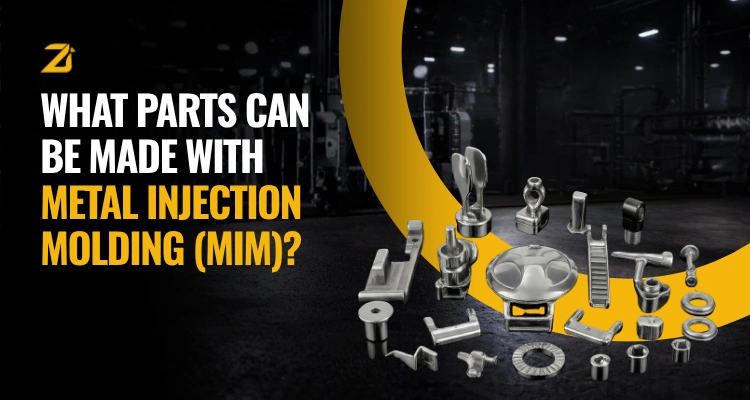
What Parts Can Be Made with Metal Injection Molding (MIM)? Across 8 Key Industries
 Digvijaysingh Rao
on
Digvijaysingh Rao
on
Introduction
Metal Injection Molding (MIM) has fundamentally changed how precision metal components are designed and produced at scale. What once required multiple machining operations — turning, milling, drilling, and finishing can now be accomplished in a single, repeatable process with dimensional tolerances as tight as +/-0.3%.
For engineering and procurement teams in India, this shift carries significant production and cost implications. MIM enables small, complex, high-volume metal parts that would be cost-prohibitive to produce using CNC machining. It opens geometries that casting cannot achieve, doing so at unit economics that improve dramatically as volumes scale.
This article documents the eight industries where metal injection molding applications in India have moved from an alternative process to the standard one.
Why MIM Has Become the Go-To Process for Small Complex Metal Parts
Metal Injection Molding sits at the intersection of powder metallurgy and plastic injection molding. It combines the shape complexity of injection molding with the material performance of wrought metal, delivering sintered density above 95%.
The process is particularly suited to components that require:
- Complex 3D geometry with undercuts, internal threads, or hollow sections
- High-volume production with consistent dimensional tolerances
- Material properties close to wrought metal: tensile strength, hardness, and corrosion resistance
- Small-to-medium part weight, typically under 100 grams
In India, metal injection molding applications are expanding across sectors where traditional methods — die casting, investment casting, CNC machining cannot simultaneously deliver the geometry, material grade, and per-unit cost that modern manufacturing demands.
Zealot Inc. has developed MIM components across 10+ industries, working with stainless steel, low alloy steel, titanium, and tungsten-based materials, backed by 25+ years of precision engineering experience.
1. Medical and Surgical - Instruments, Orthodontic Brackets, Implant Components
Medical and surgical manufacturing has adopted MIM more aggressively than virtually any other sector. The reason is straightforward: no other process achieves the combination of biocompatible material grades, tight tolerances, and complex geometry at the production volumes that device manufacturers require.
Components manufactured via MIM in this sector:
- Orthodontic brackets — conventional and self-ligating
- Surgical scissors, forcep jaws, and hinge mechanisms
- Endoscope components and biopsy device hardware
- Drug delivery device mechanisms
- Bone screws and implant fixation hardware in titanium and 316L stainless
Orthodontic brackets are one of the clearest illustrations of MIM's advantage. Each bracket requires precise slot dimensions for wire engagement, a defined base contour for bonding, and tie wings designed to specific torque and angulation values. These dimensional requirements, combined with production volumes in the millions annually, make MIM the only economically viable process.
Material grades commonly used: 316L stainless steel for biocompatibility, 17-4 PH stainless for structural strength, and titanium alloys for implant-grade applications.
For Indian dental and medical device manufacturers reducing import dependency on precision orthodontic hardware, domestic MIM production presents a viable and cost-effective alternative to international sourcing.
2. Automotive - Turbocharger Parts, Sensor Housings, Locking Mechanisms
Automotive manufacturing was one of the earliest adopters of MIM and continues to expand its component count per vehicle. The push toward vehicle lightweighting, miniaturization of mechanisms, and higher dimensional consistency has made MIM a production standard for dozens of small metal parts.
Examples of MIM parts in India’s automotive sector:
- Turbocharger vanes and variable geometry actuator components
- Door locking mechanisms and latch bodies
- Sensor housings and precision bracket assemblies
- Seats recline gear mechanisms
- Fuel injector components
- ABS system precision parts
In Gujarat, India's largest automotive manufacturing cluster — the demand for precision small metal components is substantial. Tier-1 suppliers and OEMs sourcing locally have a clear opportunity to reduce lead times and tooling costs by transitioning high-volume components from CNC machining to MIM.
A typical MIM part in the automotive locking mechanism category achieves 40–60% cost reduction versus CNC machining at volumes above 50,000 units annually. Material grades include 17-4 PH, 316L stainless, and low-alloy steel based on fatigue and corrosion requirements.
Zealot Inc. has demonstrated this transition in automotive brake component applications, moving parts from conventional machining to MIM to deliver tighter tolerances and improved surface consistency at production scale.
3. Consumer Electronics - SIM Trays, Hinges, Connectors, Shielding
Consumer electronics is the single largest volume application segment for MIM globally. The miniaturization demands of smartphones, wearables, and laptop hardware have pushed component sizes to dimensions where MIM is the only mass-production process capable of meeting geometry requirements.
Components manufactured:
- SIM card trays and ejector pin mechanisms
- Hinge assemblies for foldable and convertible devices
- USB, USB-C, and charging port connector housings
- Watch crown mechanisms and case components
- Electromagnetic shielding brackets
- Camera module retention frames
For Indian electronics manufacturers in the PLI scheme-driven production expansion, MIM provides a path to producing domestically what is currently imported at high volumes from East Asian suppliers. As production scale grows, the unit cost economics of MIM improve progressively — tooling amortization per unit falls as annual volumes rise.
Stainless steel 316L and 17-4 PH are the dominant materials. Surface finishes achievable include mirror polishing, PVD coating, and anodizing-compatible substrates, depending on downstream product specifications.
4. Firearms and Defence - Trigger Components, Safety Levers, Precision Structural Parts
The defence and small arms industries have long relied on investment casting and CNC machining for metal components. MIM has made significant inroads where component geometry is complex, tolerances are tight, and production quantities justify tooling investment.
Components manufactured:
- Trigger assemblies and sear mechanisms
- Safety levers and selector switches
- Hammer and firing pin components
- Sight adjustment and windage adjustment hardware
- Structural brackets for optical and aiming systems
Defence procurement in India, with its focus on indigenization under the IDDM (Indigenously Designed, Developed, and Manufactured) classification, creates a clear opportunity for domestic MIM manufacturers. Components previously imported can be produced locally with full material certifications and traceability documentation.
Material grades for defence applications typically require tool steel, 17-4 PH stainless, or low-alloy grades with defined hardness and impact resistance values after heat treatment.
5. Aerospace - Lightweight Brackets, Small Turbine Components
Aerospace adoption of MIM is concentrated in small, structurally complex components where material performance is non-negotiable and weight reduction is a continuous design objective.
Components manufactured:
- Fuel system valve bodies and seat components
- Turbine nozzle guide vane segments
- Structural brackets and attachment hardware
- Engine instrumentation housings
- Retention mechanisms and locking hardware for actuator systems
The aerospace specification environment is demanding. MIM components used in flight-critical applications must pass NADCAP accreditation processes, full material traceability requirements, and documented process control at every stage — from feedstock creation through sintering and secondary operations.
For Indian aerospace manufacturers and MRO suppliers supporting programs under ISRO, HAL, or Tier-2 aerospace supply chains, MIM represents a viable domestic production route for complex small metal components currently sourced from international suppliers.
Titanium alloys and nickel superalloys are relevant materials for elevated-temperature aerospace applications where MIM is increasingly being evaluated as a cost-reduction strategy versus investment casting.
6. Industrial Machinery - Gears, Valves, Fasteners, Miniature Structural Parts
Industrial machinery is a broad category with consistent demand for wear-resistant, dimensionally stable small metal components. MIM addresses this need across multiple subcategories of machinery manufacturing.
Components manufactured:
- Miniature spur gears and helical gears
- Valve bodies and flow control seat components
- Precision locking fasteners and threaded inserts
- Bearing cages and retaining ring assemblies
- Hydraulic manifold blocks for small-scale systems
- Tool holder components and precision fixtures
In the industrial machinery sector, MIM competes directly with powder metallurgy (PM) sintered parts and investment casting. MIM's primary advantage is density and precision: sintered PM parts typically reach 85-90% theoretical density, while MIM achieves 95%+, delivering mechanical properties closer to wrought material.
For Indian industrial machinery manufacturers concentrated in Pune, Coimbatore, and Ahmedabad, MIM enables local production of precision components previously sourced through CNC machining at significantly higher per-unit cost, particularly at volumes above 10,000 units annually.
7. Consumer Goods - Watch Components, Eyewear Hinges, Luxury Hardware
Consumer goods manufacturing uses MIM to produce premium small metal parts where visual quality, dimensional repeatability, and luxury material aesthetics are all required at production scale.
Components manufactured:
- Watch case components, lugs, and crown mechanisms
- Eyewear hinge assemblies and barrel hinges
- Pen and writing instrument hardware
- Precision belt buckles and fashion accessories
- Drawer pulls and cabinet hardware for premium interiors
- Zipper and fastener hardware for luxury goods
The surface quality of MIM parts — achievable Ra values below 0.8 microns before secondary finishing makes them directly usable for polished, PVD-coated, or electroplated consumer product applications without additional grinding operations.
Indian consumer goods manufacturers serving export markets for eyewear, accessories, and premium hardware have a domestic production option through MIM that reduces import costs and lead times on precision hardware currently procured from European or East Asian suppliers.
8. Textile Machinery - Precision Guides, Cams, and Wear-Resistant Components
Textile machinery represents a particularly relevant application sector for Indian MIM manufacturers. India is one of the world's largest textile producers, with concentrated machinery manufacturing clusters in Gujarat (Surat, Ahmedabad) and Tamil Nadu (Coimbatore, Tirupur).
Components manufactured:
- Thread guides and tension regulator components
- Cam mechanisms for weaving and knitting machines
- Yarn feeder components and tension device hardware
- Sinker rings and needle bed components in wear-resistant alloys
- Latch and bearded needle assemblies for warp-knit machinery
- Drive and timing components for high-speed winding equipment
Textile machinery components are characterized by high operating cycles, continuous wear exposure, and the need for dimensional consistency across high replacement volumes. MIM in tool steel or wear-resistant alloy grades provides a cost-effective alternative to imported German or Japanese precision parts that currently dominate the Indian textile machinery aftermarket.
Zealot Inc. serves textile machinery clients across western India, providing precision guides and wear components with material hardness specifications matched to specific machine models and operating environments.
Is MIM Right for Your Component? Key Manufacturability Criteria
MIM delivers its strongest value proposition when the following production parameters are met:
| Factor | MIM-Optimized Range |
|---|---|
| Part Weight | 0.1 g to 100 g |
| Annual Volume | 5,000 to 5,000,000+ units |
| Wall Thickness | 0.5 mm to 10 mm |
| Dimensional Tolerance | +/-0.3% to +/-0.5% |
| Geometry Complexity | High: undercuts, threads, internal features |
If your component falls outside these parameters for example, large structural parts over 500 grams, or annual volumes below 1,000 units alternative processes such as investment casting or CNC machining may offer better economics.
For components within these parameters, MIM typically delivers 40–70% cost reduction versus CNC machining at mature production volumes, with no post-machining required in most applications.
Frequently Asked Questions (FAQs)

Digvijaysingh Rao
Head of Sales & Strategy
Digvijaysingh Rao leads sales and business development at Zealot Inc. He works closely with customers to understand their production challenges and recommend solutions that are practical and easy to maintain.