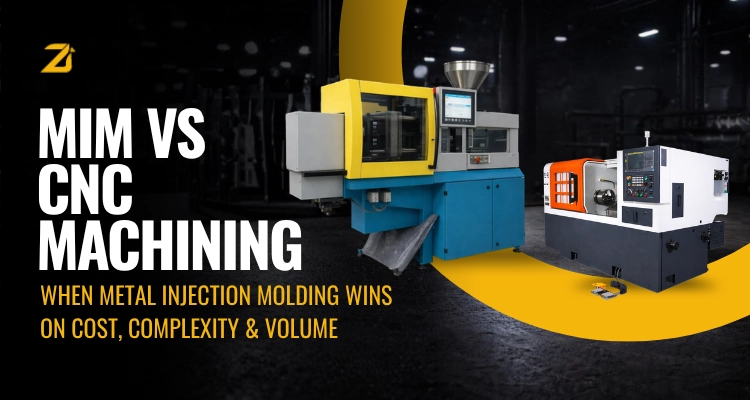
MIM vs CNC Machining: When Metal Injection Molding Wins on Cost, Complexity & Volume
 Digvijaysingh Rao
on
Digvijaysingh Rao
on
Introduction
For manufacturing decision-makers, choosing the right production method is the difference between scalable profitability and margin-eroding bottlenecks. The debate of MIM vs CNC machining is increasingly critical as global supply chains demand higher precision at lower unit costs. While CNC machining has long been the default for tight tolerances, Metal Injection Molding (MIM) is aggressively disrupting the landscape for complex, high-volume production.
This guide breaks down the economics, geometry capabilities, and scalability of both processes. At Zealot Inc., our MIM engineers advanced precision components that eliminate traditional machining constraints. By understanding these technical differences, industrial leaders can confidently transition to highly efficient, mass-production workflows that maximize long-term ROI.
Key Takeaways
- CNC machining is optimal for low-volume, highly customized, or excessively large metal components.
- Metal injection molding combines the design freedom of plastic injection molding with the durability of fully dense metal parts.
- The break-even point in a metal injection molding vs CNC machining cost analysis typically occurs between 10,000 and 20,000 units annually.
- MIM significantly reduces material waste, making it highly cost-effective for expensive alloys like titanium and stainless steel.
- Zealot Inc. has developed over 70 MIM products across more than 10 industries, delivering high precision and consistency for complex geometries.
Overview - MIM vs CNC Machining in India
India's manufacturing sector is undergoing a rapid transformation, moving toward high-value, export-driven production. In this 2025+ industrial landscape, cost pressure and the demand for miniaturization are forcing engineers to evaluate their production lines. CNC (Computer Numerical Control) machining is a subtractive process where software-controlled tools remove material from a solid block to create a final shape. It is highly precise but inherently generates waste and requires significant machine time per unit.
Conversely, Metal Injection Molding (MIM) is an additive-style molding process. It utilizes powdered metal mixed with a binder, injected into a mold, and then sintered to achieve full density. A thorough MIM machining comparison India context reveals that while CNC is excellent for prototyping, MIM is the superior choice for scaling intricate parts. As global supply chains diversify, Indian manufacturers adopting MIM gain a massive competitive edge in unit economics and production speed.
Process Comparison - How Each Method Works
Understanding the fundamental workflow differences clarifies why scalability varies so drastically between the two methods. CNC machining operates sequentially. A technician programs the toolpaths, secures a raw metal billet, and the machine cuts away material. Complex parts often require multiple setups, different cutting tools, and repositioning, which exponentially increases cycle times and labor.
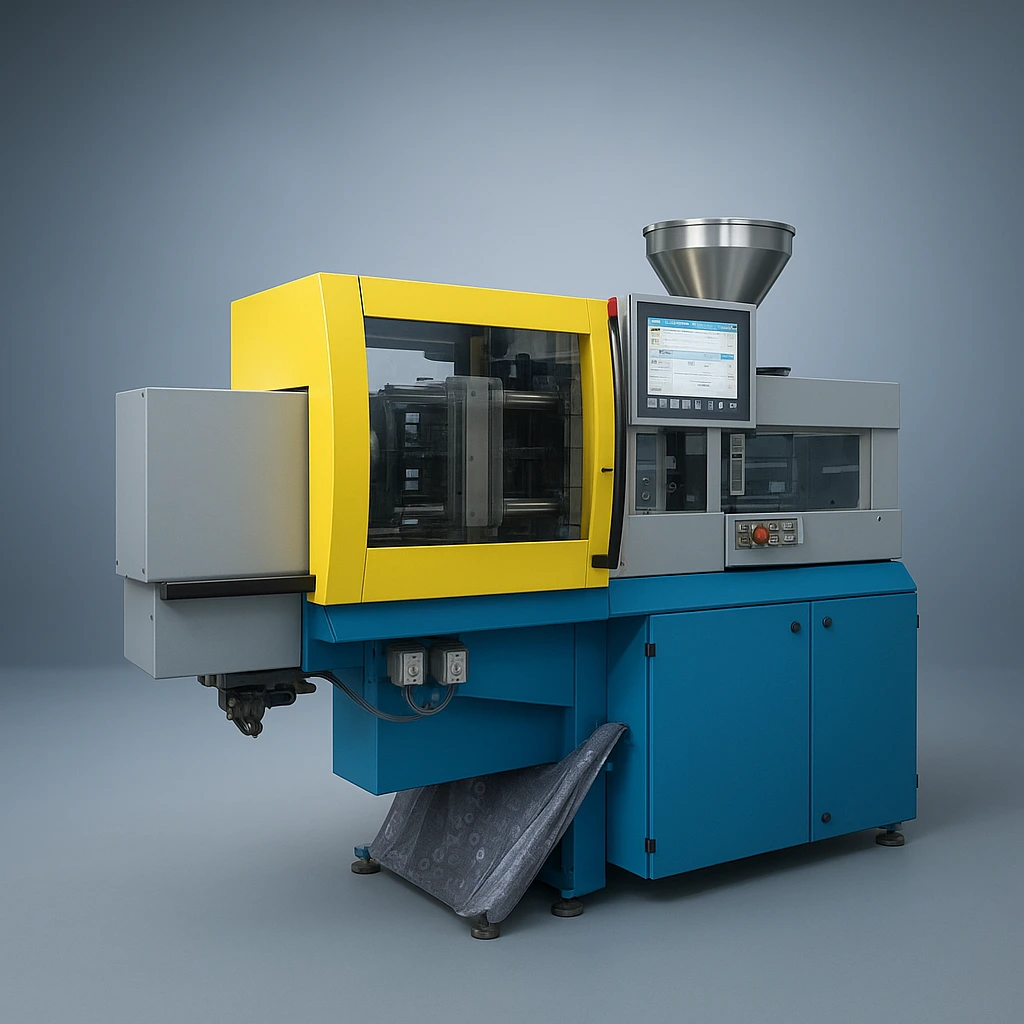
MIM, however, operates on a batch-processing model designed for massive throughput. The MIM process steps include:
- Mixing: Fine metal powder is combined with a thermoplastic binder.
- Feedstock: This mixture is cooled and granulated into a moldable feedstock.
- Molding: The feedstock is injected into a custom die to form a "green part."
- Debinding: The binder material is chemically or thermally removed to create a "brown part."
- Sintering: The part is heated in a furnace near melting point, densifying into a solid precision component.
- Finished Good: The final component requires little to no secondary operations.
Cost Breakdown - Tooling vs Per-Part Economics
The financial debate between these two processes hinges on the relationship between upfront capital and amortized unit costs. CNC machining boasts very low initial tooling costs. You only need the raw material, standard cutting tools, and the programming time. However, the per-part cost remains relatively static. Whether you machine 100 parts or 10,000 parts, the machine time and material waste dictate a rigid baseline expense.
MIM requires a significant upfront investment in custom mold tooling. However, once the mold is created, the cycle time to produce a part is measured in seconds, not hours. The per-part cost drops precipitously as volume increases. Furthermore, MIM utilizes nearly 100% of the raw material, eliminating the financial loss of scrap metal—a critical factor when processing expensive alloys.
Comparison Table
| Parameter | CNC Machining | Metal Injection Molding (MIM) | Industrial Impact |
|---|---|---|---|
| Best Volume Range | 1 to 10,000 units per month | 15,000+ units per day | MIM drives massive cost reductions for high-volume commercial and industrial scale. |
| Tooling Cost | Very Low | Higher than CNC (Custom Molds) | CNC is better for small production; MIM requires strategic upfront capital for long-term ROI. |
| Per-Part Cost | High and Static | Very Low at Volume | MIM achieves superior economies of scale. |
| Material Waste | High (Subtractive) | Minimal (Additive/Molding) | MIM protects margins when using high-value alloys. |
| Design Complexity | Increases Cost Significantly | Does Not Impact Cost | MIM allows for freeform design without financial penalty. |
| Size Constraints | Can handle very large parts | Ideal for micro to small parts | MIM is perfect for miniaturization in electronics and medical devices. |
Complexity - Why MIM Wins for Intricate Parts
Geometry is often the ultimate deciding factor in manufacturing capability. CNC machining is limited by tool access. If a cutting tool cannot physically reach an internal cavity, or if the angle requires a 5-axis machine, costs skyrocket. Sharp internal corners, thin walls, and complex undercuts are notoriously difficult and expensive to machine.
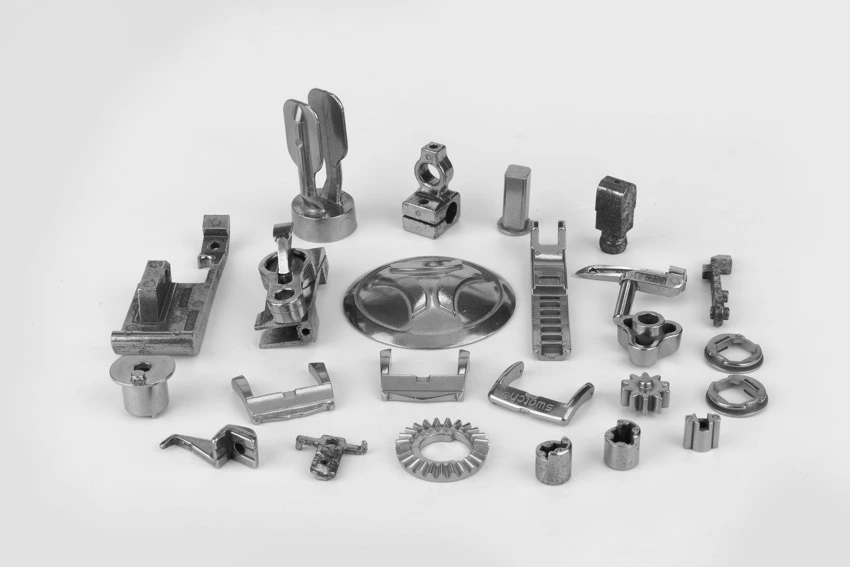
Because MIM utilizes a molding process, geometric complexity does not increase the per-part cost. If a shape can be designed into a mold, it can be mass-produced. MIM excels at producing micro to small components with complex geometries, high precision, and consistency. This makes it the premier choice for industries demanding intricate designs, such as aerospace, automotive, medical and surgical instruments, and electronics.
Volume - When Machining Stops Making Sense
Scaling production with CNC machining is a linear and capital-intensive endeavor. To double your output, you often need to double your number of CNC machines, double your floor space, and double your skilled operators. This scalability ceiling limits rapid growth and restricts agility during demand spikes.
MIM was inherently designed for mass production. A single mold can have multiple cavities, producing 4, 8, or 16 parts in a single injection cycle. Sintering furnaces process thousands of parts simultaneously. When transitioning from 50,000 to 500,000 units, MIM requires virtually zero additional capital expenditure, offering an unmatched economy of scale.
Accuracy, Finish & Material Considerations
Both processes deliver exceptional accuracy, but they achieve it differently. CNC machining can hold extremely tight tolerances (down to ±0.005 mm) right off the machine. MIM typically holds tolerances of ±0.03 to ±0.05mm of the nominal dimension. For the vast majority of industrial, automotive, and consumer applications, this tolerance is perfectly sufficient. If ultra-tight tolerances are required on a specific feature, a MIM part can undergo a rapid secondary operation just on that single feature.
Regarding materials, Zealot's MIM capabilities encompass a wide spectrum, including stainless steel, low alloy steel, tool steel, tungsten alloys, and titanium alloys. MIM components achieve 96% to 99% of wrought material density, resulting in exceptional tensile strength and durability that rivals or exceeds machined parts.
When to Use MIM Not Machining
Determining when to use MIM not machining comes down to analyzing your production matrix. You should actively transition to Metal Injection Molding when:
- Annual volumes exceed 15,000 units: At this threshold, the tooling cost is fully amortized, and the unit cost savings become substantial.
- The part weighs less than 100 grams: MIM is optimized for micro to small components. Larger parts are better suited for traditional investment casting or machining.
- The geometry is highly complex: If your part requires 5-axis machining, edm spark or wire cut multiple setups, or features internal channels and undercuts, MIM will drastically reduce your expenses.
- Material waste is eroding margins: If you are machining away more than 40% of an expensive raw block (like titanium or specialized stainless steel), MIM’s zero-waste process is mandatory.
- Consolidating multiple parts: If you currently machine three separate components and weld them together, MIM allows you to design and mold them as a single, stronger, unified piece.
Common Decision Mistakes Indian Manufacturers Make
Despite the clear advantages, many supply chain leaders make costly strategic errors when evaluating their manufacturing lines.
- Overusing CNC for Mass Production: Continuing to use CNC for high-volume parts simply because "it's how we've always done it" results in bloated unit costs and wasted machine capacity.
- Ignoring Tooling ROI: Procurement teams sometimes reject MIM due to the initial mold cost, failing to calculate the Total Cost of Ownership (TCO) over a 2-to-3-year production lifecycle.
- Designing for Machining, Not for Manufacturing: Engineers often design parts based on subtractive limitations. By designing specifically for MIM from the ground up, companies unlock massive weight reductions and functional improvements.
- Underestimating Scalability Constraints: Relying on CNC shops for sudden volume spikes often leads to missed deadlines. MIM ensures production elasticity.
Conclusion
The debate of MIM vs machining India is ultimately a question of scale and strategic foresight. CNC machining will always hold a vital place in manufacturing for prototyping, low volume runs, and exceptionally large components. However, when complex geometries meet high-volume demands, Metal Injection Molding is unequivocally the superior financial and operational choice.
By leveraging MIM, B2B manufacturers can eliminate material waste, consolidate assemblies, and drastically reduce per-part costs while maintaining rigorous global quality standards. Zealot brings over 25 years of engineering experience to precision metal component manufacturing. We partner with ambitious companies to transition their production lines, ensuring they remain highly competitive in the global market.
Ready to optimize your production economics? Talk to a Zealot MIM Engineer today.
Frequently Asked Questions (FAQs)
Read More:
- How Cast Nylon Is Made: The Anionic Polymerization Process Explained Simply
- What is Metal Injection Molding (MIM)? Complete Beginner’s Guide
- What is Cast Nylon (MC Nylon)? Complete Guide for Manufacturers
- Understanding Metering, Mixing, and Dispensing Systems for PU
- What is Polyurethane Dispensing and How Does It Work

Digvijaysingh Rao
Head of Sales & Strategy
Digvijaysingh Rao leads sales and business development at Zealot Inc. He works closely with customers to understand their production challenges and recommend solutions that are practical and easy to maintain.