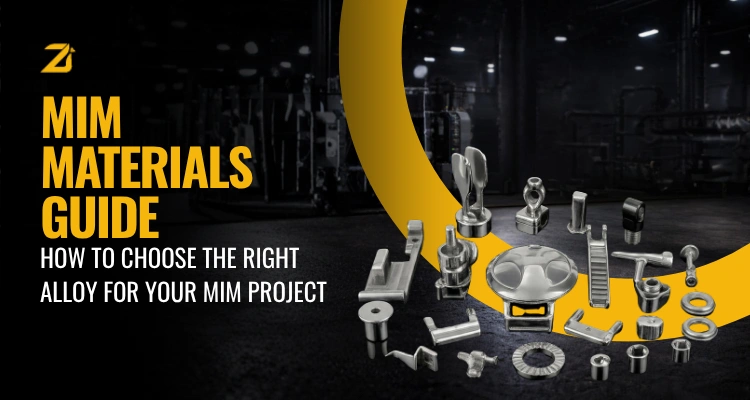
MIM Materials Guide: How to Choose the Right Alloy for Your Metal Injection Molding Project
 Digvijaysingh Rao
on
Digvijaysingh Rao
on
Introduction
In Metal Injection Molding, alloy selection is not a downstream decision. It governs part density, dimensional accuracy, surface finish, sintering shrinkage behavior, and long-term service performance. A wrong material specification leads to tooling rework and qualification delays that are difficult to recover from once a program enters production.
India's MIM sector has matured considerably over the past decade. For buyers ac Domestic suppliers now process a wider range of alloys, serve export customers in Europe and North America, and are evaluated against tighter dimensional and documentation standards than five years ago. ross automotive, medical, aerospace, and precision industrial sectors, material-process compatibility is a front-end engineering requirement, not a procurement afterthought.
This guide covers four core MIM material families used in Indian manufacturing: stainless steel, titanium, tool steel, and specialty alloys. Each section provides engineering-level performance data, application fit, manufacturability trade-offs, and cost context for Indian production and export requirements. This serves as a practical reference for engineers and procurement managers specifying metal injection molding materials in India.
MIM for Stainless Steel Parts
Stainless steel accounts for the majority of MIM production volumes globally and in India. Its combination of mechanical strength, corrosion resistance, and well-understood sintering behaviour makes it the primary choice for most material evaluations across automotive, medical, and industrial sectors.
Key Grades and Engineering Profiles
- 17-4 PH Stainless Steel: A precipitation-hardened martensitic grade delivering tensile strength above 1,000 MPa in the H900 condition. Low distortion during sintering makes it suitable for tight-tolerance parts such as automotive latch mechanisms, dental instruments, and precision fasteners.
- 316L Stainless Steel: Standard choice where corrosion resistance takes priority over mechanical strength. The low-carbon designation minimizes sensitization during sintering, retaining intercrystalline corrosion resistance in the final part. Specified for surgical instruments, implantable hardware brackets, and marine or chemical-contact components. For medical sector applications in India, 316L is the baseline alloy for specification.
- 420 Stainless Steel: Offers hardness of 50 to 56 HRC after heat treatment and is selected when wear resistance governs the design. Typical end uses include valve components, cutting instrument bodies, and nozzle tips. Its lower corrosion resistance compared to 316L requires careful evaluation in wet or chemically aggressive service environments.
Applications Across Indian Industry Sectors
Stainless MIM components are in active production use across India's automotive supplier base in Pune and Chennai, surgical instrument manufacturers in western India, and precision hardware exporters in Gujarat. The ability to produce near-net-shape stainless steel parts at volumes above 10,000 pieces per year is the primary driver of MIM adoption in these industrial clusters.
Heat treatment after sintering, including precipitation hardening for 17-4 PH and quench-and-temper cycles for 420 grade, is standard practice in Indian MIM production. These steps must be factored into lead time and total cost planning from the design phase.
Manufacturability and Post-Processing
MIM stainless steel parts shrink approximately 15 to 20% linearly during sintering. This is predictable and compensated through mold scaling, but it requires matched shrinkage data between the tooling supplier and the MIM manufacturer. Tolerance capability in production is typically plus or minus 0.3 to 0.5% of nominal dimension, with tighter values achievable through secondary operations on critical features.
Post-sintering finishing options for stainless grades include vibratory deburring, electropolishing, passivation, and precision grinding. Electropolishing is specifically relevant for medical and food-contact applications where surface roughness and biofilm resistance are specified requirements.
MIM for Titanium Parts
Titanium MIM is technically demanding but increasingly viable for Indian manufacturers targeting aerospace, defence, and medical implant markets. The process parameters differ significantly from stainless steel and require dedicated sintering infrastructure.
Biocompatibility and Structural Performance
Grade 1 to Grade 4 commercially pure titanium and Ti-6Al-4V are the primary alloys processed via MIM. Ti-6Al-4V delivers tensile strength of approximately 950 to 1,100 MPa at a density of only 4.43 g/cm³. This strength-to-weight ratio is unmatched among standard MIM materials and is the primary technical driver for its use in aerospace and implant applications.
For titanium MIM parts targeting implantable medical applications, biocompatibility is a regulatory baseline. CP titanium and Ti-6Al-4V ELI grade both meet ISO 5832-3 requirements for implant use. These alloys are specified for dental implant components, orthopaedic fasteners, and surgical fixation hardware where osseointegration performance is a design requirement.
Aerospace and Defence Applications in India
India's expanding aerospace and defence manufacturing base under the Make in India initiative is a direct growth area for titanium MIM components. Structural brackets, precision fasteners, sensor housings, and connector hardware for unmanned systems and avionics packages are produced in Ti-6Al-4V where weight reduction without structural compromise is critical.
Private defence manufacturers in Hyderabad and Bengaluru, along with DRDO-linked supply chains, are increasingly evaluating domestically sourced MIM titanium parts as import substitution priorities for program-critical sub-components.
Cost-Performance and Supplier Qualification
Titanium feedstock costs are approximately 5 to 8 times higher than 316L stainless. Processing also requires tighter atmospheric control during debinding and sintering to prevent oxygen and nitrogen pickup, which directly degrades mechanical properties.
Buyers should assess a supplier's vacuum sintering furnace capability and interstitial content testing practice before specifying titanium MIM for structural or implant applications. Atmospheric furnaces used for stainless steel production are not suitable for titanium MIM processing.
MIM Tool Steel
MIM Tool steel serves applications where hardness, wear resistance, and high-cycle fatigue performance are the governing design requirements. These are specialised MIM applications requiring tighter process control, defined heat treatment sequences, and secondary finishing operations.
Common Grades and Performance Data
- M2 High-Speed Steel: Achieves hardness in the range of 62 to 66 HRC after sintering and heat treatment, with strong red hardness retention at elevated temperatures. Used for cutting tool inserts, drill bit components, gear hobs, and precision stamping punches.
- H13 Hot Work Tool Steel: Selected for elevated-temperature service conditions, including injection mold cores, extrusion components, and die casting inserts. Its toughness at 650 degrees Celsius and thermal fatigue resistance make it well-suited for cyclic thermal loading.
- D2 Tool Steel: Offers high chromium content alongside extreme wear resistance. Applied in forming dies, wire drawing components, and wear plates where continuous abrasive contact is present throughout the service life.
India's Tooling Sector as an End-Use Market
India's tooling and die manufacturing sector, concentrated in Rajkot, Pune, and Ludhiana, is a growing end-use base for MIM tool steel components. Short-run tooling inserts, precision punch sets, and wear-resistant guide components are increasingly produced via MIM as a cost-effective alternative to conventional grinding and EDM of solid bar stock, particularly for parts with complex internal geometries.
Design and Process Guidelines
Quench distortion is a risk for thin-walled or asymmetric tool steel MIM parts. Designers must account for section transitions and minimum wall thickness early in the design cycle. Secondary grinding or EDM finishing after sintering is fully compatible with MIM-produced tool steel components and is standard practice for precision-critical features and mating surfaces.
MIM Alloys Selection Guide in India
Selecting the right alloy is a multi-variable engineering decision. Mechanical requirements, environmental exposure, production volume, and programme cost all determine the final specification. The following framework applies to Indian manufacturing and export contexts.
Primary Selection Criteria
- Mechanical properties in service: Define minimum tensile strength, yield strength, hardness, and fatigue limit before evaluating alloy options. Do not over-specify grades. Selecting 17-4 PH for an application that 316L satisfies adds cost without measurable engineering benefit.
- Corrosion and environmental exposure: Medical and food-contact applications require austenitic stainless steel or titanium. Automotive under-hood parts with exposure to coolants or hydraulic fluids require alloys with defined chemical resistance, typically 316L or 17-4 PH. Dry industrial environments allow consideration of 420 or tool steel grades.
- Thermal performance: Applications exceeding 300 degrees Celsius in service require precipitation-hardened grades, tool steel, or nickel-based alloys. Standard austenitic stainless steel is not suitable for sustained high-temperature service conditions.
When to Prioritise Each Material
Specify 316L when corrosion resistance and biocompatibility are the primary requirements and strength demands are moderate. Specify 17-4 PH when both high strength and reasonable corrosion resistance are required simultaneously. Specify titanium when part weight, implant biocompatibility, or aerospace structural certification requirements must all be satisfied together. Specify tool steel grades when hardness above 55 HRC or wear resistance under continuous abrasive contact is the governing design factor.
Regional Insights for Indian Industrial Hubs
Gujarat-based manufacturers are increasingly specifying MIM for export-grade automotive fasteners and precision hardware components. Near-net-shape production reduces per-piece cost significantly compared to imported CNC components at volumes above 10,000 pieces per year.
The western India industrial corridor benefits from established logistics infrastructure connecting manufacturing clusters to JNPT and Mundra ports, reducing export transit times for MIM components destined for European and North American buyers.
Cost-Performance Reference Table
| Material | Relative Feedstock Cost | Strength Reference | Primary Application |
|---|---|---|---|
| 316L Stainless | Low | 480 to 620 MPa | Medical, Industrial, Marine |
| 17-4 PH Stainless | Medium | 1,000 to 1,300 MPa | Automotive, Defence, Tooling |
| 420 Stainless | Low-Medium | 700 to 950 MPa after HT | Valves, Cutting Instruments |
| Ti-6Al-4V | High | 950 to 1,100 MPa | Aerospace, Implants |
| M2 Tool Steel | High | 62 to 66 HRC | Cutting Tools, Wear Components |
Frequently Asked Questions (FAQs)
Read More:
- What Parts Can Be Made with Metal Injection Molding (MIM)? Across 8 Key Industries
- Metal Injection Molding (MIM) Design Guidelines: Complete DFM Guide
- The MIM Process Step by Step: From Metal Powder to Precision Component
- Is MIM Right for Your Part? The Complete Decision Framework for Indian Manufacturers
- MIM vs CNC Machining: When Metal Injection Molding Wins on Cost, Complexity & Volume

Digvijaysingh Rao
Head of Sales & Strategy
Digvijaysingh Rao leads sales and business development at Zealot Inc. He works closely with customers to understand their production challenges and recommend solutions that are practical and easy to maintain.