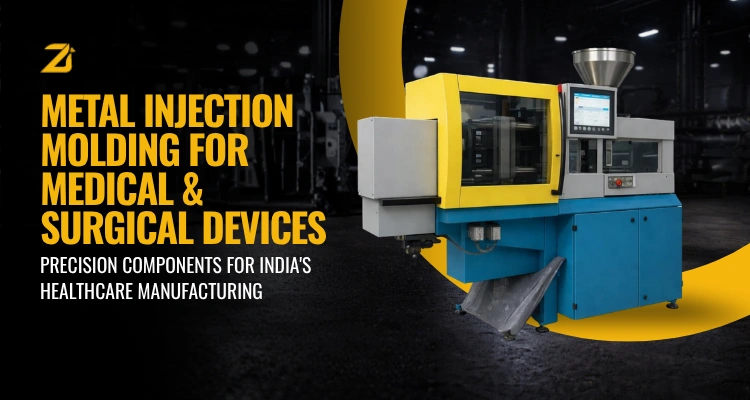
Metal Injection Molding for Medical & Surgical Devices: Precision Components for India’s Healthcare Manufacturing
 Digvijaysingh Rao
on
Digvijaysingh Rao
on
Introduction
A surgical instrument that flexes where it should lock, or a component that sheds particles under repeated sterilization, is not a minor defect. In medical device manufacturing, dimensional consistency and material integrity are patient safety requirements, not quality preferences. Metal injection molding (MIM) has become one of the standard routes for producing the small, complex, corrosion-resistant metal components this standard demands, and India's healthcare manufacturing sector is building the domestic capability to produce them at home rather than import them.
This guide covers what MIM actually produces for medical and surgical applications, the biocompatible materials involved, the quality and regulatory framework that governs medical MIM in India, and how to evaluate whether MIM is the right process for a given component.
Key Takeaways
- MIM produces small, geometrically complex medical and surgical components, including laparoscopic jaws, forceps tips, endoscopic mechanisms, orthodontic brackets, and implant-adjacent parts, at volumes and tolerances machining struggles to match economically.
- The three material families that cover most medical MIM work are 316L stainless steel for general surgical and temporary-implant use, 17-4PH stainless steel for higher-strength instrument components, and titanium alloys for permanent implants.
- MIM 316L reaches 97 to 99% theoretical density with an as-sintered surface finish around Ra 0.6 to 1.3 µm, smooth enough for many surgical applications without secondary polishing.
- Medical MIM components fall under the same quality framework as the finished device: ISO 13485 quality management, ISO 10993 biological evaluation, and full lot traceability, regardless of which company molds the part.
- In India, medical device components are regulated under the Medical Device Rules 2017 through CDSCO, with devices classified A through D by risk, which determines the documentation a component supplier needs to support.
- India's Production Linked Incentive scheme for medical devices is pushing device OEMs to localize manufacturing, which is expanding demand for domestically produced precision components including MIM parts, even though the scheme itself targets finished equipment categories rather than components directly.
- MIM is not automatically the right process for every medical component. Very low-volume parts, very large parts, or parts needing alloys outside the common MIM material range are often better served by machining or investment casting.
Quick Answer: What Does MIM Offer Medical and Surgical Device Manufacturing?
| Material | Typical Density | As-Sintered Surface Finish | Typical Use |
| 316L stainless steel | 97 to 99% theoretical | Ra 0.6 to 1.3 µm | Surgical instruments, temporary implants, general medical hardware |
| 17-4PH stainless steel | Above 97% theoretical | Ra 0.8 to 1.6 µm | Higher-strength instrument components, non-implant wear parts |
| Titanium (Ti-6Al-4V) | Above 97% theoretical | Ra 0.8 to 1.6 µm | Permanent implants, implant-adjacent components requiring osseointegration |
Why Medical and Surgical Devices Demand a Different Manufacturing Standard
Medical components are getting smaller and more mechanically complex, and at the same time regulatory scrutiny is increasing. A laparoscopic instrument tip a few millimeters across may need an internal articulation mechanism, a locking feature, and a corrosion-resistant surface that survives hundreds of autoclave cycles without degrading. Traditional machining can hit these targets on a part-by-part basis but holding the same tolerance and finish across tens of thousands of identical parts, with full lot traceability back to a specific powder batch, is a different manufacturing problem.
This is the gap MIM fills. Because the part forms in a mold rather than being cut from stock, geometry that would need multiple machining setups, or that machining cannot reach at all, comes out of a single molding cycle. Combined with sintered densities above 97% of theoretical, MIM components approach the mechanical properties of wrought metal while holding the complex, repeatable geometry that miniaturized medical devices increasingly require.
What Surgical and Medical Components Are Made with MIM
MIM components appear across several categories of medical and surgical devices, each with a distinct requirement driving the choice.
Surgical instruments
Forceps tips, needle holder jaws, scissor blades, clip applicators, and retractor components rely on MIM for sharp, precise geometry combined with corrosion resistance across repeated sterilization cycles.
Minimally invasive and endoscopic devices
Laparoscopic grasper jaws, articulation mechanisms, locking systems, and other miniature structural components inside endoscopes depend on MIM's ability to mold complex internal features that would be difficult to machine inside such a small envelope.
Implant and implant-adjacent components
Bone anchors, suture anchor bodies, and structural components adjacent to permanent implants use MIM in 316L, 17-4PH, or titanium depending on whether the part is temporary or intended to remain in the body.
Dental components
Orthodontic brackets and dental implant components are among the highest-volume MIM medical applications, where part-to-part consistency directly affects fit across a large patient population.
Drug delivery and dosing mechanisms
Pen injector and inhaler mechanism components need the dimensional consistency MIM provides to keep dosing accurate across the full-service life of the device.
Biocompatible Materials for Medical MIM
Material selection in medical MIM is not a styling choice. It determines whether a component is suitable for temporary contact, permanent implantation, or neither.
316L Stainless Steel
316L stainless steel is the workhorse of medical MIM, accounting for a large share of medical MIM production industry wide. Its low carbon content resists sensitization during processing, which preserves corrosion resistance in the chloride-rich environment of body fluids. MIM 316L typically reaches 97 to 99% theoretical density with tensile strength in the range of 520 to 540 MPa, meets ISO 10993 biocompatibility requirements, and withstands repeated autoclave sterilization. It is the default choice for surgical instruments and temporary implants.
17-4PH Stainless Steel
17-4PH stainless steel offers significantly higher strength after heat treatment, commonly in the range of 1,070 to 1,280 MPa, with hardness up to around 43 HRC. This makes it well suited to instrument components that need superior wear resistance, such as cutting edges and locking mechanisms, though its lower corrosion resistance compared with 316L generally limits it to non-implant applications.
Titanium Alloys
Titanium alloys, most commonly Ti-6Al-4V, are used where permanent implantation is involved. Titanium's biocompatibility and ability to support bone ingrowth make it the material of choice for implant-adjacent structural components, at a materially higher cost than either stainless steel option.
For a fuller breakdown of alloy selection across MIM applications generally, not only medical, see MIM Materials Guide: How to Choose the Right Alloy for Your Metal Injection Molding Project .
Quality and Regulatory Requirements Specific to Medical MIM
A medical MIM component inherits the regulatory weight of the finished device it goes into, even though the molder is a component supplier rather than the device manufacturer of record.
ISO 13485
ISO 13485 is the quality management system standard most device OEMs expect from a medical component supplier, covering process control, document control, and corrective action in a way general ISO 9001 certification does not fully address for regulated medical production.
ISO 10993
ISO 10993 governs the biological evaluation of medical device materials, and is the standard referenced when a supplier claims a material such as 316L or titanium is biocompatible for a given contact duration and body location.
Lot Traceability
Lot traceability back to a specific powder lot, feedstock batch, and sintering run is standard practice in medical MIM, since a nonconformance discovered after parts have shipped needs to be traceable to every affected unit.
Medical Device Rules 2017 and CDSCO
In India, medical devices and their components fall under the Medical Device Rules 2017, administered by the Central Drugs Standard Control Organization (CDSCO). Devices are classified A through D by risk, from low-risk Class A devices through high-risk Class D devices such as implantable cardiac products, and the classification of the finished device shapes how much documentation, testing, and audit evidence a component supplier is expected to support.
India's Medical Device Manufacturing Opportunity
India's medical device sector has historically depended heavily on imports, particularly for high-technology categories such as diagnostic imaging, implants, and critical-care equipment. The government's response has included the Production Linked Incentive scheme for medical devices, an outlay of roughly ₹3,420 crore offering a 5% incentive on incremental domestic sales across four device segments: cancer care and radiotherapy, radiology and imaging, anesthetics and cardio-respiratory and renal care devices, and implants.
The PLI scheme itself targets finished high-end equipment categories rather than funding component suppliers directly. Its practical effect on the component supply chain is indirect but significant: as device OEMs localize final assembly to capture these incentives, they need a domestic supplier base for the precision components, including MIM parts, that go into those devices. A domestic MIM manufacturer that can meet ISO 13485-aligned quality expectations is positioned to serve exactly this shift, supplying both the OEMs building toward CDSCO Class C and D devices and the broader surgical instrument and dental device manufacturers who need biocompatible components without importing them.
Why MIM Outperforms Machining and Casting for Medical Components
Machining remains a valid route for medical components, particularly at low volume or for very large parts, but it becomes expensive fast once a component has internal features, undercuts, or a complex profile that needs multiple setups to cut. MIM forms that same geometry in one molding cycle, which is why it becomes cost-competitive against machining well before volumes reach the range typically associated with metal molding processes. For a detailed volume and cost comparison specific to the Indian market, see Metal Injection Molding Cost in India and MIM vs CNC Machining .
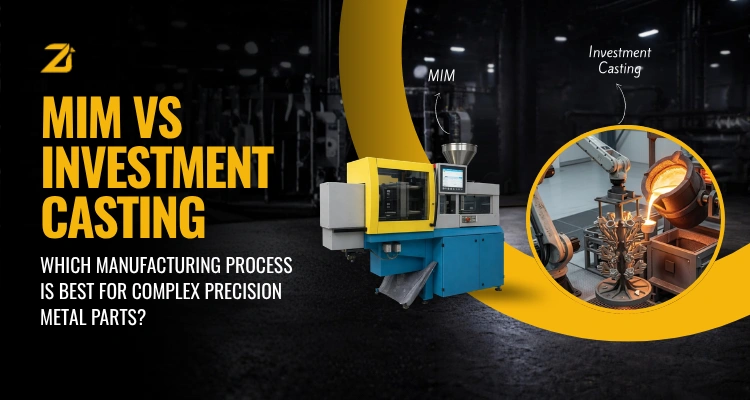
Investment casting is the other process medical component buyers frequently weigh against MIM, particularly for larger implant-adjacent parts. It holds looser tolerances and a rougher as-cast surface finish than MIM, which often means more secondary machining before a part is ready for a sterile field. See MIM vs Investment Casting for the full comparison.
Designing Medical Components for MIM
Medical components carry design rules on top of the standard MIM shrinkage and draft considerations that apply to any part. Wall thickness needs to stay within MIM's practical range to sinter evenly without warping, articulation features need clearance built in for the roughly 15 to 20% linear shrinkage that occurs during sintering, and surfaces intended for tissue contact or repeated sterilization often need a finish specification called out on the drawing rather than left to the as-sintered default. A DFM review before tooling is cut catches these issues while they are still inexpensive to fix. For the general MIM design rules that apply before layering on medical-specific finish and traceability requirements, see Metal Injection Molding (MIM) Design Guidelines: Complete DFM Guide .
Common Mistakes When Specifying Medical MIM Components
Assuming as-sintered finish is automatically sterile-field ready
As-sintered 316L can reach Ra 0.6 to 1.3 µm, which is smooth enough for many applications, but components with direct patient contact or fine articulation surfaces often need electropolishing or mechanical polishing specified explicitly, since the as-sintered default is not always sufficient on its own.
Specifying 17-4PH for a permanent implant application
17-4PH's strength advantage does not carry the same corrosion resistance as 316L or titanium in long-term implant service. Material choice needs to match contact duration and location, not just mechanical strength.
Treating a medical MIM supplier's ISO 9001 certification as equivalent to ISO 13485
General quality certification does not automatically cover the document control, risk management, and traceability requirements a regulated medical device build expects from its component suppliers.
Underestimating CDSCO documentation lead time
Confirming the finished device's risk classification and the documentation a component supplier will be expected to support should happen early in sourcing, not after tooling has already been committed.
Why Manufacturers Choose Zealot for Medical MIM
Zealot Inc. produces metal injection molded components and lists Medical & Surgical among the core industries it serves, alongside Automotive, Aerospace, Defense, Electrical and Electronics, and Textile. Every MIM program starts with a DFM review and first article inspection before full production, the same discipline that applies across Zealot's MIM work regardless of industry.
For manufacturers evaluating a specific surgical instrument or implant-adjacent component, the starting point is a conversation about the part's geometry, material, and target volume rather than a generic process recommendation. See MIM for Medical & Surgical Industry for Zealot's dedicated medical and surgical MIM capabilities.
Frequently Asked Questions (FAQs)
Read More:
-
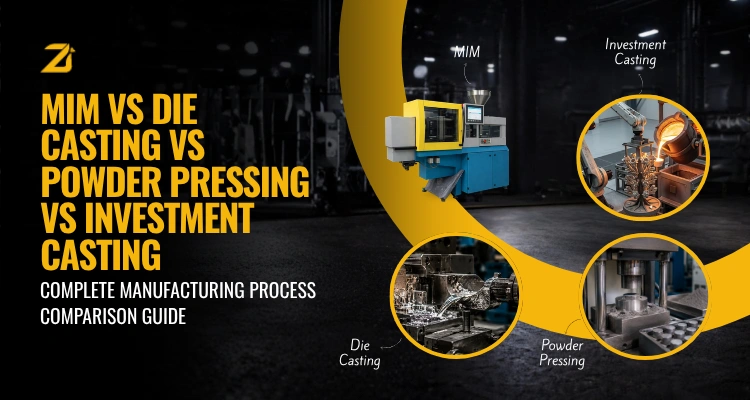
- MIM vs Die Casting vs Powder Pressing vs Investment Casting: Complete Manufacturing Process Comparison Guide
- Metal Injection Molding Cost in India: When MIM Becomes More Cost-Effective Than Machining, Casting, and CNC Manufacturing
- What Parts Can Be Made with Metal Injection Molding (MIM)? Across 8 Key Industries
- Metal Injection Molding (MIM) Design Guidelines: Complete DFM Guide

Digvijaysingh Rao
Head of Sales & Strategy
Digvijaysingh Rao leads sales and business development at Zealot Inc. He works closely with customers to understand their production challenges and recommend solutions that are practical and easy to maintain.