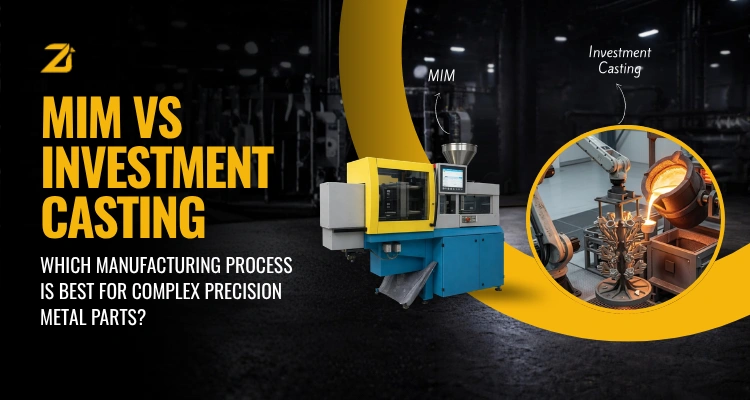
MIM vs Investment Casting: Which Manufacturing Process Is Best for Complex Precision Metal Parts?
 Digvijaysingh Rao
on
Digvijaysingh Rao
on
Introduction
Selecting the right manufacturing process is one of the most important decisions in precision metal component development. While both Metal Injection Molding (MIM) and Investment Casting produce near-net-shape parts with excellent mechanical performance, they serve different design, production, and commercial requirements. Factors such as part geometry, dimensional tolerances, production volume, material selection, tooling investment, and long-term manufacturing costs all influence which process delivers the best value.
This guide provides a technical comparison of MIM and Investment Casting, explaining where each process performs best, their design limitations, cost implications, and ideal production scenarios. Whether you're an engineer optimizing a new component or a procurement team evaluating manufacturing options, this framework will help you select the most appropriate process based on measurable engineering and business criteria.
Key Takeaways
- Metal Injection Molding (MIM) is best for small, highly complex metal parts that require tight tolerances, thin walls, and high-volume production.
- Investment Casting is the preferred choice for larger components, lower production volumes, and applications that require a wider range of alloys, including nickel-based superalloys.
- Production volume plays a critical role because MIM delivers the lowest cost per part at high volumes, while Investment Casting typically offers lower tooling costs for small and medium production runs.
- Part size, wall thickness, material selection, and design complexity should be evaluated before choosing a manufacturing process.
- Comparing total lifecycle costs, including tooling, machining, lead time, and annual production volume, helps identify the most economical manufacturing method.
MIM vs Investment Casting: Which Process Is Right for Complex Precision Metal Parts?
Selecting between Metal Injection Molding and investment casting is one of the most consequential decisions in the design-to-production cycle for complex metal parts. Both processes achieve near-net-shape geometries, both serve precision-demanding industries, and both involve tooling investment. Yet they operate through fundamentally different mechanisms, suit different production volumes, and deliver different outcomes on tolerance, surface finish, and unit cost.
This guide compares MIM vs investment casting across every relevant engineering and procurement dimension so you can make a process decision based on data, not assumptions.
Why Choosing the Right Manufacturing Process Matters
Process selection affects far more than manufacturing method. It determines achievable tolerances, permissible wall thicknesses, minimum economical order quantities, tooling amortization timelines, and total cost per part across the full production lifecycle.
A process chosen incorrectly at the design stage creates cascading cost penalties: oversized tooling investment for a low-volume run, secondary machining costs that could have been avoided, or surface finishes requiring post-processing that adds lead time and expense.
For engineers designing complex precision components and for procurement teams evaluating suppliers, the core question is not which process is more advanced. It is which process fits the specific part geometry, material requirement, production volume, and cost envelope.
Getting this decision right at the RFQ stage prevents redesign, retooling, and production delays downstream.
What Is Metal Injection Molding (MIM)?
Metal Injection Molding (MIM) is an advanced powder metallurgy process that combines the design flexibility of plastic injection molding with the mechanical strength of wrought metal. Fine metal powders are mixed with a thermoplastic binder to create a feedstock, which is then injected into a precision mold to produce complex near-net-shape components with exceptional dimensional accuracy.
After molding, the green part undergoes debinding to remove the binder, followed by high-temperature sintering, typically between 1,200°C and 1,400°C. During sintering, the component shrinks in a controlled manner by approximately 15 to 20 percent, resulting in a dense metal part with more than 96 percent of theoretical density and excellent mechanical properties.
MIM typically delivers dimensional tolerances of ±0.3 to ±0.5 percent of the nominal dimension and as-sintered surface finishes of Ra 1 to 3 microns, minimizing the need for secondary machining. The process supports a wide range of materials, including stainless steels (316L, 17-4 PH, 304L), low-alloy steels, tool steels (M2, D2), titanium alloys (Ti-6Al-4V), tungsten alloys, and copper alloys.
Because it can produce intricate geometries with thin walls, undercuts, internal features, and consistent repeatability, MIM is ideally suited for manufacturing small, complex metal components in high production volumes where conventional machining would be expensive and investment casting may not achieve the same level of precision.
What Is Investment Casting?
Investment casting, also known as lost-wax casting, is a precision manufacturing process used to produce complex metal components with excellent dimensional accuracy and surface finish. The process begins by creating a wax pattern of the final part, which is coated with a ceramic shell. Once the shell hardens, the wax is melted away, leaving a cavity into which molten metal is poured. After solidification, the ceramic shell is removed to reveal the finished casting.
One of the key advantages of investment casting is its ability to produce intricate geometries, including internal passages, undercuts, and contoured surfaces that are difficult or costly to manufacture using conventional machining. Unlike Metal Injection Molding, investment casting can produce components ranging from a few grams to more than 50 kilograms, making it suitable for both small precision parts and large structural components.
Investment casting typically achieves dimensional tolerances of ±0.1 to ±0.25 mm on smaller features, with tolerances varying as part size increases. It also provides as-cast surface finishes in the range of Ra 1.5 to 3.5 microns. The process supports a wide variety of materials, including carbon steel, alloy steels, stainless steels, aluminium alloys, nickel-based superalloys, titanium, cobalt-chrome, and duplex stainless steels.
Because of its material versatility and ability to manufacture larger, high-strength components, investment casting is widely used for medium-volume production in industries such as aerospace, oil and gas, power generation, automotive, pumps, valves, and general engineering.
MIM vs Investment Casting: Side-by-Side Comparison
| Requirement | Recommended Material | Reason |
| High Abrasion, Wet Particle Contact | Hard PU (MDI) | Outperforms rubber and unlined steel in sliding abrasion with no corrosion failure mode. |
| High Impact Combined with Abrasion | Hard PU (MDI, 85 to 95 Shore A) | Provides exceptional toughness with surface hardness that rubber cannot match at equivalent hardness. |
| Very High Elongation or Flex Fatigue | Rubber | Hard PU has limited elongation at high hardness, making it unsuitable for large elastic deflection. |
| Extreme Low Temperature Flexibility | Rubber | Retains flexibility at low temperatures better than most standard hard PU grades. |
| Chemical and Oil Resistance with Medium Load | Hard PU (MDI) | Offers broad chemical compatibility and lower swelling compared to rubber. |
| Maximum Structural Rigidity, Zero Flex | Metal (Steel or Aluminum) | PU and rubber deform beyond acceptable limits under high point loads. |
| Noise and Vibration Reduction, Low Load | Rubber or Hard PU | Both materials dampen vibration better than metal, while rubber is better for lower load and higher flex applications. |
| Continuous Operating Temperature Above 100°C | Metal or Heat Stable Rubber | Exceeds the reliable thermal service limit of standard hard PU systems. |
When to Choose Metal Injection Molding
MIM is the right manufacturing process when the following conditions apply:
- Production volume is high: MIM tooling requires a higher upfront investment, but it becomes highly cost-effective for annual production volumes above 5,000 to 10,000 parts, resulting in a lower cost per part than machining or investment casting.
- The component is small and geometrically complex: MIM excels at manufacturing parts below 100 grams with intricate features such as internal threads, cross-holes, undercuts, and wall thicknesses as thin as 0.5 mm.
- Consistent dimensional accuracy is essential: The injection molding process provides repeatable tolerances across large production runs while minimizing the need for secondary machining.
- High density and mechanical strength are required: MIM achieves 96 to 99 percent sintered density, making it suitable for structural, medical, and high-performance precision components.
Industries where MIM is the standard process:
- Medical and surgical instruments (forceps, endoscopic components, orthodontic parts)
- Automotive (fuel system components, sensor housings, lock mechanisms)
- Industrial automation (actuator parts, precision linkages)
- Firearms and defence hardware
- Consumer electronics (SIM trays, hinge mechanisms, wearable device components)
- Lock hardware and industrial fasteners
When to Choose Investment Casting
Investment casting is the right manufacturing process when the following conditions apply:
- Part size exceeds MIM's practical range: MIM is generally limited to components below 100 to 150 grams, while investment casting can efficiently produce much larger parts without the same size constraints.
- Production volume is low to medium: For annual volumes of approximately 100 to 2,000 parts, investment casting offers lower tooling costs and is often more economical than amortizing MIM tooling.
- High-temperature alloys or superalloys are required: Components such as aerospace turbine blades, power generation parts, and industrial burner components often require nickel- or cobalt-based superalloys that are better suited to investment casting.
- Large structural sections or internal passages are needed: Investment casting can produce large wall sections, complex internal channels, and structural geometries that exceed the practical size and density limits of MIM.
Industries where investment casting is the standard process:
- Aerospace and defence (turbine blades, structural brackets, actuation components)
- Oil and gas (valve bodies, pump impellers, manifolds)
- Power generation (burner components, turbine parts)
- Automotive (exhaust manifolds, turbocharger housings)
- General engineering (gearbox housings, structural brackets, pump casings)
Quick Decision Matrix
| Requirement | Recommended Process | Reason |
| Part Weight Below 100 Grams | MIM | Optimized for small, lightweight components with high material density. |
| Part Weight Above 200 Grams | Investment Casting | Exceeds the practical production range for Metal Injection Molding. |
| Volume Above 10,000 Units per Year | MIM | Tooling costs are amortized, resulting in a low per-part cost at high production volumes. |
| Volume Below 2,000 Units per Year | Investment Casting | Requires a lower tooling investment for short production runs. |
| Tolerance Requirement of ±0.3% | MIM | Delivers high molding precision on critical dimensions and complex features. |
| High Temperature Superalloy Required | Investment Casting | MIM is generally not commercially viable for most superalloy applications. |
| Thin Wall Geometry Below 1 mm | MIM | Injection molding technology consistently fills very thin sections with high accuracy. |
| Large Structural Component | Investment Casting | Supports significantly larger part sizes without the practical limitations of MIM. |
| Near Wrought Mechanical Properties at Small Scale | MIM | Achieves 96% to 99% sintered density for excellent mechanical performance. |
| Minimal Secondary Machining Budget | MIM | Near net shape manufacturing minimizes post processing and machining costs. |
Key Design Considerations Before Selecting a Process
- Part size and mass: MIM is generally limited to components weighing 100 to 150 grams with linear dimensions under 100 mm. Larger parts are typically better suited to investment casting or another metal forming process.
- Wall thickness: MIM can produce wall thicknesses as thin as 0.5 mm with proper part design, while investment casting generally requires a practical minimum wall thickness of 1.5 mm and becomes more challenging below 2 mm.
- Internal features: Both processes can create internal geometries, but MIM is better suited for intricate small-scale features. Investment casting relies on ceramic cores to produce larger internal passages and hollow sections.
- Draft angles and undercuts: MIM tooling accommodates undercuts using side actions and collapsible cores. Investment casting creates similar features through wax patterns and ceramic cores, often with greater tooling complexity.
- Material requirements: Investment casting is the preferred choice for components requiring nickel-based superalloys, cobalt-chrome alloys, or other advanced materials that are not commonly available for MIM. MIM is limited to commercially available sinterable alloy systems.
- Production quantity and cost modeling: Compare tooling investment, unit cost, secondary machining, and projected annual production before selecting a process. The economic crossover between MIM and investment casting often occurs between 3,000 and 8,000 parts per year, depending on part geometry, material, and manufacturing requirements.
Conclusion
Metal Injection Molding and Investment Casting each offer distinct advantages, making the right choice dependent on your component's design and production requirements. MIM is ideal for small, highly complex parts produced in high volumes, while Investment Casting is better suited to larger components, lower production runs, and a broader range of alloys.
Before selecting a process, evaluate part size, geometry, material compatibility, tolerance requirements, annual production volume, and overall manufacturing costs. Considering these factors early helps avoid unnecessary tooling, machining, and production expenses.
By matching the manufacturing process to your application, you can improve product quality, optimize costs, and achieve a more efficient production workflow from prototype to full-scale manufacturing.
Frequently Asked Questions (FAQs)
Read More:
- Cast Nylon vs Injection-Moulded Nylon: Which Performs Better in High-Load Industrial Applications?
- How Cast Nylon Is Made: The Anionic Polymerization Process Explained Simply
- What is Cast Nylon (MC Nylon)? Complete Guide for Manufacturers
- MIM vs CNC Machining: When Metal Injection Molding Wins on Cost, Complexity & Volume

Digvijaysingh Rao
Head of Sales & Strategy
Digvijaysingh Rao leads sales and business development at Zealot Inc. He works closely with customers to understand their production challenges and recommend solutions that are practical and easy to maintain.