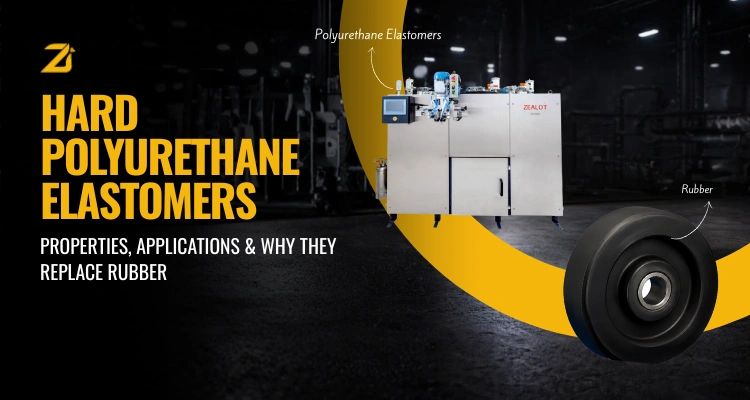
Hard Polyurethane Elastomers: Properties, Applications & Why They Replace Rubber
 Digvijaysingh Rao
on
Digvijaysingh Rao
on
Introduction
Hard polyurethane elastomers are cast PU materials engineered in the upper Shore A to Shore D hardness range. They outperform standard rubber compounds in abrasion resistance, load-bearing capacity, compression set, and oil resistance, which is why industrial engineers increasingly specify hard PU over rubber for wear parts, rollers, and liners.
Rubber remains the default material for many industrial wear components because of low material cost and simple processing. In abrasive, high-load, or oil-contact environments, rubber wears quickly, takes a permanent compression set, and requires frequent replacement. Hard PU is engineered to address these specific failure points.
This article explains what makes a polyurethane elastomer "hard," how its engineering properties compare to rubber, and when the substitution case is strongest. It is written for engineers, maintenance heads, procurement teams, and plant managers evaluating wear-resistant materials for industrial components.
Key Takeaways
- Hard polyurethane elastomers range from approximately 80 Shore A to 80 Shore D and beyond, covering applications where standard rubber compounds fail under load or abrasion
- Hard PU outperforms rubber in abrasion resistance, compression set, and oil resistance under sliding wear and sustained-load conditions
- Rubber remains the better choice for very high elongation, low-temperature flexibility, and full elastic recovery at low hardness
- MDI-based hard PU systems deliver higher achievable hardness, better thermal stability, and stronger hydrolysis resistance than TDI systems
- Hard PU reduces wear-driven maintenance cycles in mining, conveyor, and roller applications where rubber liners and coverings degrade quickly
- Material selection depends on load type, abrasion mechanism, temperature, and chemical exposure, not hardness alone
- Casting process control, particularly degassing and stoichiometric ratio accuracy, directly determines the mechanical output of hard PU parts
What Makes a Polyurethane Elastomer 'Hard'? (Shore A vs Shore D Explained)
Polyurethane elastomers exist on a continuous hardness scale from very soft (20 Shore A) to rigid (80 Shore D and above). The Shore A scale covers soft to medium-firm materials, the range where most conventional rubber compounds also sit. The Shore D scale applies to harder, structurally rigid systems that approach the stiffness of engineering plastics.
Hardness in PU elastomers is controlled at the formulation level through the ratio of hard segments to soft segments in the polymer chain. Increasing isocyanate content, selecting aromatic MDI over aliphatic alternatives, and adjusting chain extender type and concentration all shift hardness output upward. At 95 Shore A and into Shore D territory, PU parts exhibit limited elastic deformation under load and begin behaving more like structural plastics than conventional elastomers.
Hard PU is not simply stiff rubber. Its molecular architecture produces a combination of properties that rubber cannot replicate at equivalent hardness: controlled deformation, energy absorption, high abrasion resistance, and dimensional recovery under cyclic loading.
Properties of Hard PU Elastomers Compared to Rubber
Hard PU elastomers are defined by a performance profile across multiple engineering parameters directly relevant to components traditionally made from rubber.
- Tensile Strength: High-hardness cast PU elastomers achieve tensile strength in the range of 40 to 70 MPa depending on chemistry and cure conditions. Standard rubber compounds typically fall well below this range, which limits rubber in structural or high-load contact applications.
- Abrasion Resistance: In standardized sliding and impingement abrasion testing, hard PU elastomers consistently outlast natural and synthetic rubber compounds by a wide margin. The performance gap widens further in environments with fine abrasive particles and wet contact.
- Compression Set: This is where rubber loses the most ground. Rubber compounds take a permanent set under sustained load and lose sealing or contact force over time. Well-cured hard PU systems exhibit substantially lower compression set, maintaining dimensional stability under continuous load.
- Impact Resistance: Unlike rigid plastics, hard PU elastomers absorb impact energy without catastrophic fracture, while offering far greater surface hardness than rubber. This combination is the core engineering advantage over rubber at the wear-resistance boundary.
- Load Bearing: At 90 Shore A and above, PU parts carry significantly higher static and dynamic loads than rubber equivalents at the same volume, without permanent deformation.
- Operating Temperature: Most commercial hard PU elastomers perform reliably from approximately 20°C to 90°C continuous service. Rubber generally retains flexibility across a wider low-temperature range and can tolerate higher continuous heat in some compounds, which remains a genuine rubber advantage in specific thermal environments.
When to Use Hard PU Instead of Rubber
The substitution case for hard PU over rubber is strongest when at least two of the following conditions apply simultaneously.
- Load-Bearing Capacity: Standard rubber compounds deform significantly under sustained load and are unsuitable for structural or high-load contact applications. Hard PU carries substantially higher static and dynamic loads while maintaining dimensional stability under service conditions.
- Abrasion and Cut Resistance: Rubber wears rapidly under sliding abrasion and is prone to cutting, chunking, and tearing in sharp-particle environments. Hard PU delivers significantly higher abrasion and tear resistance under the same operating conditions.
- Dimensional Stability: Rubber compounds swell in contact with oils and certain industrial fluids and are prone to creep under continuous load. Hard PU holds tighter dimensional tolerances over the full service life of the component.
- Compression Set Performance: Rubber loses recovery capacity over repeated compression cycles, resulting in permanent set and reduced sealing or contact performance. Hard PU retains a lower compression set, extending service life in roller coverings and load-bearing seals.
- Chemical and Oil Resistance: Many rubber grades degrade, swell, or soften on contact with oils, fuels, and industrial solvents. Hard PU, particularly MDI-based systems, resists a broader range of industrial chemicals without loss of mechanical properties.
The substitution case does not apply where the application requires very high elongation, extreme low-temperature flexibility, or full elastic recovery at low hardness. In these conditions, standard rubber compounds remain the more suitable material choice.
How Hard PU Compares to Rubber Across Industrial Applications
- Mining and Mineral Processing: Hydrocyclone liners, screen panel inserts, pump impellers, and slurry handling components cast in hard PU outperform rubber-lined equivalents in continuous abrasive slurry contact, extending service intervals in wet mineral processing applications.
- Material Handling: Chute liners, hopper wear plates, belt conveyor idler rollers, and impact bars in rubber wear quickly under repeated particle impact. Replacing these with hard PU extends maintenance intervals and reduces liner replacement frequency.
- Industrial Rollers and Wheels: Hard PU roller coverings replace rubber in steel plant contact rolls, industrial printing rollers, and heavy industrial cart and AGV wheels, where both load capacity and abrasion resistance exceed what rubber coverings can sustain.
- Conveyor Systems: Drive wheels, guide rollers, return idlers, and belt support components cast in hard PU reduce replacement frequency compared to rubber equivalents in high-tonnage conveying environments under sustained cyclic loading.
- OEM Equipment Manufacturing: Industrial machinery OEMs specify hard PU in place of rubber for components exposed to cyclic abrasion, medium-to-high loads, and oil or chemical contact that shortens rubber service life.
How Hard PU Parts Are Manufactured (Casting Process for High-Hardness Systems)
Hard polyurethane components are produced through a liquid casting process that requires precision at each stage to achieve consistent hardness and mechanical integrity.
- System Selection: MDI or TDI prepolymer is selected based on the hardness target, thermal requirements, and end-use environment. MDI systems are preferred for hard, high-performance industrial parts.
- Degassing: Both prepolymer and chain extender are degassed under vacuum before mixing to eliminate trapped air. Porosity from dissolved gases reduces strength and creates surface defects in finished parts.
- Mold Preparation: Molds are preheated to the specified temperature and coated with release agent. Metal inserts for bonded components such as roller cores are surface-prepared and primed to ensure reliable adhesion to the cast elastomer.
- Mixing and Dispensing: Prepolymer and curative are combined in precisely controlled stoichiometric ratios. Deviation from the correct ratio degrades crosslink density and directly reduces hardness and mechanical properties. Zealot's polyurethane dispensing systems provide controlled variable ratio mixing for consistent hard elastomer output. [Link: Zealot Polyurethane Dispensing Machine]
- Curing: Cast parts are cured in temperature-controlled ovens. Hard PU systems typically require post-cure at 100 to 120°C for several hours to achieve full crosslink density and target hardness.
- Post-Processing: Demolded parts are trimmed, inspected, and machined where required to achieve final dimensional tolerance. Hard PU can be processed using standard cutting tools, unlike many rubber compounds that require specialized cutting to avoid tearing.
MDI vs TDI for Hard Elastomers: Which Gives Better Results?
Both MDI (Methylene Diphenyl Diisocyanate) and TDI (Toluene Diisocyanate) are used in cast polyurethane elastomer production. For high-hardness industrial applications, the chemistry choice has a direct and significant impact on final part performance.
MDI-based systems produce higher modulus elastomers with better thermal stability, improved hydrolysis resistance, and a broader achievable hardness range extending into the Shore D zone. MDI parts maintain mechanical properties more reliably at elevated temperatures and under sustained dynamic loading. This makes MDI the standard for industrial mining wear components, material handling applications, and heavy-duty OEM parts previously specified in rubber.
TDI systems are more commonly applied in softer to medium elastomers ranging from 60 to 90 Shore A. They offer more processing latitude and are suitable for applications where extreme hardness and thermal performance are not primary requirements.
For hard PU applications in Indian industrial environments, which frequently involve high ambient temperatures, humid operating conditions, and chemical exposure, MDI-based systems provide a more reliable and consistent performance profile across the component service life than either TDI-based PU or standard rubber.
Hard PU vs Rubber vs Metal: Quick Decision Matrix
| Requirement | Recommended Material | Reason |
| High Abrasion, Wet Particle Contact | Hard PU (MDI) | Outperforms rubber and unlined steel in sliding abrasion with no corrosion failure mode. |
| High Impact Combined with Abrasion | Hard PU (MDI, 85 to 95 Shore A) | Provides exceptional toughness with surface hardness that rubber cannot match at equivalent hardness. |
| Very High Elongation or Flex Fatigue | Rubber | Hard PU has limited elongation at high hardness, making it unsuitable for large elastic deflection. |
| Extreme Low Temperature Flexibility | Rubber | Retains flexibility at low temperatures better than most standard hard PU grades. |
| Chemical and Oil Resistance with Medium Load | Hard PU (MDI) | Offers broad chemical compatibility and lower swelling compared to rubber. |
| Maximum Structural Rigidity, Zero Flex | Metal (Steel or Aluminum) | PU and rubber deform beyond acceptable limits under high point loads. |
| Noise and Vibration Reduction, Low Load | Rubber or Hard PU | Both materials dampen vibration better than metal, while rubber is better for lower load and higher flex applications. |
| Continuous Operating Temperature Above 100°C | Metal or Heat Stable Rubber | Exceeds the reliable thermal service limit of standard hard PU systems. |
Key Design Considerations Before Replacing Rubber With Hard PU
- Wall Thickness: Hard PU parts require adequate wall thickness to ensure even cure and avoid surface-to-core hardness gradients. Thin-walled designs carried over directly from rubber tooling can create cure inconsistency and reduce mechanical integrity.
- Load and Deformation Balance: Hard PU deforms less than rubber at equivalent geometry, so components designed around rubber's flexibility may need dimensional adjustment when converted to hard PU.
- Temperature Exposure: Continuous operating temperatures above 90 to 100°C degrade PU mechanical properties progressively. Applications relying on rubber's higher heat tolerance should be reviewed carefully before switching to standard commercial hard PU grades.
- Bonded Metal Inserts: Many industrial hard PU components are cast over metal cores, similar to bonded rubber parts. Surface blasting, chemical priming, and mold temperature management are all critical to bond integrity.
- Production Volume Economics: Cast PU tooling costs are lower than metal casting tooling and comparable to rubber molding for medium-volume runs. For very high-volume, simple-geometry parts where rubber's low material cost dominates, rubber may remain more cost-effective and should be evaluated on a per-application basis.
Conclusion
Hard polyurethane elastomers occupy a well-defined engineering space between flexible rubber and rigid structural materials. When selected against the correct application criteria, they reduce wear rates, extend component service life, resist oils and chemicals that degrade rubber, and lower total maintenance cost in abrasive industrial environments.
The substitution logic is not universal. Elongation requirements, low-temperature flexibility, and continuous heat exposure determine whether rubber remains the correct choice. When abrasion resistance, load capacity, and oil resistance matter most, hard PU consistently outperforms rubber on a total cost of ownership basis across most industrial wear applications.
Zealot Inc. engineers and supplies cast polyurethane elastomer dispensing systems compatible with MDI and TDI chemistries, supporting hard PU industrial casting applications for buyers across India and international markets replacing rubber and metal components alike.
Frequently Asked Questions (FAQs)
Read More:
- Cast Nylon vs Injection-Moulded Nylon: Which Performs Better in High-Load Industrial Applications?
- How Cast Nylon Is Made: The Anionic Polymerization Process Explained Simply
- What is Cast Nylon (MC Nylon)? Complete Guide for Manufacturers
- MIM vs CNC Machining: When Metal Injection Molding Wins on Cost, Complexity & Volume

Digvijaysingh Rao
Head of Sales & Strategy
Digvijaysingh Rao leads sales and business development at Zealot Inc. He works closely with customers to understand their production challenges and recommend solutions that are practical and easy to maintain.