Polyurethane Elastomer Applications Across 8 Key Industries
 Digvijaysingh Rao
on
Digvijaysingh Rao
on
Introduction
Industrial operating environments in India are shifting toward high-performance materials. Heavy machinery, infrastructure development, and automated assembly lines require components that tolerate aggressive physical conditions without failing. Traditional materials — vulcanized rubber, engineering plastics, and industrial metals frequently fall short under continuous mechanical stress, high thermal loads, and corrosive chemical environments.
Cast polyurethane elastomers bridge the gap between flexible rubbers and rigid structural plastics. They deliver exceptional load-bearing performance, tensile strength, and chemical resistance across service conditions where conventional materials cannot compete. Understanding polyurethane elastomer applications in India reveals how manufacturers reduce total cost of ownership while improving equipment uptime across critical sectors.
Why Indian Manufacturers Are Adopting Cast PU at Scale
The expanding market for industrial polyurethane in India is driven by the need to eliminate unplanned downtime and improve machinery efficiency. Standard elastomeric components suffer from premature tearing, rapid abrasive wear, and compression set under heavy cyclical loading. These failures disrupt production cycles, increase rejection rates, and erode facility profitability.
Cast polyurethane's liquid casting process allows engineers to tailor the material to each specific application. By modifying chemical composition, plants precisely control hardness, rebound resilience, tear propagation resistance, and fluid compatibility. Engineers can also adjust the elastomer's rebound characteristics to match the specific dynamic loading pattern of each application.
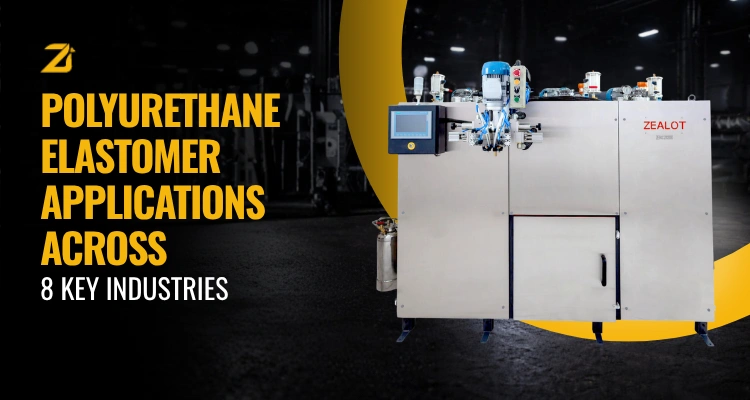
Achieving these performance characteristics at industrial scale requires automated mixing and dispensing technology. Modern plants use variable ratio low-pressure dispensing machines with digital PLC control to maintain exact chemical stoichiometry and processing temperature. This eliminates the inconsistencies and curing defects associated with manual batch processing, lowering material waste and producing a repeatable manufacturing process that can be validated against international quality standards.
Key performance advantages driving adoption:
- Expansive Hardness Range: Formulations span 60 Shore A to over 85 Shore D, maintaining elasticity even at maximum durometers.
- Superior Abrasion Resistance: Outperforms standard rubber by up to ten to one in high-velocity slurry and sliding friction applications.
- High Dynamic Load Capacity: Bears heavy compressive loads without permanent structural deformation.
1. Automotive: Seals, Gaskets, and Under-Hood Components
Automotive OEMs select cast PU for suspension bushings, high-pressure seals, engine mounts, protective gaskets, and drive belt components. The material's dampening capability significantly reduces noise, vibration, and harshness in both commercial and passenger vehicles. High tear propagation resistance ensures seals and gaskets hold under severe pressure spikes.
Under-hood components face constant exposure to oils, greases, hydraulic fluids, and elevated running temperatures. Cast polyurethane retains full structural integrity under these conditions, outperforming nitrile and chloroprene rubbers on every key performance metric. This stability minimizes seal failures, prevents fluid leaks, and extends vehicle service intervals.
Assembly plants achieve tighter engineering tolerances and improved long-term component reliability by switching to cast PU. Reduced component failure rates directly lower warranty costs and after-market claims. Consistent material properties also reduce the risk of field failures that damage long-term customer relationships.
2. Steel and Metal Processing: Rollers and Conveyor Parts
Steel facilities run continuously under extreme weight, heat, and structural friction. The sector relies on high-durometer cast PU for hold-down rollers, tension sleeves, slitter rings, coil storage saddles, and conveyor guide plates. These components protect raw metal coils and machinery from surface damage during processing.
Polyurethane rollers provide a high coefficient of friction for stable strip tracking without scratching or marking finished metal surfaces. High load-bearing capacity prevents flat-spotting and internal heat build-up during high-speed slitting, pickling, and coating operations. Steel producers reduce surface scrap rates and maintenance overhead by replacing metal-to-metal contact zones with cast PU coverings.
The vibration damping properties of cast PU reduce structural resonance in heavy rolling mill equipment. This lowers noise levels on the plant floor and contributes to a safer working environment. Both production efficiency and workplace compliance improve as a result.
3. Mining: Hydrocyclone Liners, Screens, and Wear Pads
Mining operations manage highly abrasive slurries, heavy impacts, and corrosive mineral ores. Equipment parts require frequent replacement unless protected by high-performance wear linings. Cast PU is used for hydrocyclone liners, flotation impellers, vibrating screen mats, chute liners, and scraper blades.
Screen mats resist blinding and pegging due to high elasticity and smooth surface finish, optimizing material separation accuracy. The material absorbs high-velocity impact energy from falling rocks, protecting underlying steel structures from structural erosion. This extends equipment operational windows and reduces the frequency of hazardous maintenance interventions.
Lower replacement frequency keeps mineral processing lines running at capacity with fewer unscheduled stoppages. Higher hydrocyclone geometry stability maintains processing accuracy across high-volume ore separation, delivering better mineral recovery rates and lower cost-per-ton extraction.
4. Pharmaceuticals: Conveyor Wheels and Process Rollers
Pharmaceutical facilities require contamination-free environments that comply with strict regulatory hygiene standards. Cleanroom-grade cast PU wheels, driving rollers, and sorting guides prevent mechanical friction from shedding particles into the production zone. Non-porous surfaces resist bacterial growth and material absorption throughout high-volume processing.
Cast PU formulations withstand aggressive sanitizing agents, clean-in-place cycles, and alcohol-based solvents without degrading. This chemical stability preserves component geometry, prevents contamination risks, and supports compliance with FDA and international cleanroom standards.
Automated packaging and sorting lines run at high velocities without tracking errors when cast PU components are in place. The consistency of these parts directly reduces the risk of product recalls associated with material degradation. This makes cast PU a defensible and cost-justified specification for pharmaceutical procurement teams.
5. Wind Energy: Blade Root Inserts and Vibration Dampers
Wind turbine structures require materials that endure outdoor exposure and cyclic mechanical loads over extended service periods. Cast polyurethane is used for blade root inserts, vibration isolation dampers, cable protection sleeves, and offshore bend stiffeners. Each application is engineered to manage high structural stress and environmental exposure simultaneously.
These parts absorb structural shocks and distribute mechanical stresses evenly across turbine assemblies. Components face UV radiation, salt spray, moisture, and temperature fluctuations throughout their operational life. Cast PU maintains stable physical properties under these conditions, preventing material fatigue in remote and offshore installations.
By dampening rotational vibrations generated by large turbine blades, elastomeric inserts protect the generator housing and extend the operational lifespan of the entire wind energy asset.
6. Printing and Packaging: Nip Rollers and Feed Wheels
High-speed printing and packaging machinery demands precise dimensional accuracy to avoid registration errors and web breaks. Plants utilize cast PU nip rollers, ink distribution rollers, feed wheels, and doctor blades across continuous production lines. The material's uniform durometer hardness across the full roller face eliminates differential wear that causes tracking drift during long print runs.
Cast PU resists swelling and degradation when exposed to printing inks, chemical solvents, washes, and industrial adhesives. This chemical compatibility preserves roller geometry and ensures accurate web tension at high operating speeds. Consistent feeding performance reduces unplanned stoppages and lowers per-run scrap rates.
The reduction in roller distortion minimizes mechanical friction and prevents excessive heat build-up during continuous operation. This improves overall equipment effectiveness and reduces unscheduled maintenance windows on fast-paced production lines.
7. Material Handling: Forklift Wheels and Pallet Mover Castors
Logistics hubs, warehouses, and manufacturing plants put continuous heavy stress on industrial wheels. Facilities use cast PU for forklift wheels, AGV guide rollers, pallet mover castors, and overhead conveyor wheels. These components carry heavy payloads while maintaining low rolling resistance across shift-long operations.
High resistance to chunking, tearing, and flat-spotting over uneven floors and expansion joints ensures consistent, safe operation. A strong polyurethane-to-hub bond prevents delamination under dynamic loading and heat build-up. This directly extends wheel service life and lowers replacement downtime across large warehouse fleets.
Minimizing rolling resistance lowers battery consumption in electric forklift fleets, extending operational shift lengths and reducing energy costs per unit moved. Cast polyurethane also protects industrial flooring from marking and gouging, lowering surface repair costs in high-traffic facility areas.
8. Construction: Sieve Plates, Gaskets, and Pipeline Liners
Construction machinery handles abrasive aggregate mixtures, cement slurries, and heavy structural materials daily. Cast PU is used for aggregate sieve plates, concrete mixer liners, heavy-duty pipe gaskets, and internal pipeline liners. These parts protect equipment from premature wear caused by friction from sand, gravel, and stone aggregates.
The material's low friction coefficient maintains high flow efficiency and prevents cement slurry build-up inside pipes. High tear strength resists gouging from sharp aggregate particles, reducing structural maintenance costs on job sites.
The high impact resilience of cast PU ensures aggregate sorting screens maintain accurate aperture dimensions under continuous mechanical shaking. This prevents out-of-specification material from entering the batching process, supporting consistent concrete quality and reliable delivery schedules.
Technical Performance Matrix
| Industrial Segment | Typical Hardness Range | Primary Stress Factor | Key Material Requirement |
|---|---|---|---|
| Automotive | 80 Shore A to 95 Shore A | Vibrational stress, oil exposure | High dampening, fluid resistance |
| Steel Processing | 70 Shore A to 60 Shore D | High nip pressure, sharp edges | Cut resistance, high friction |
| Mining Equipment | 60 Shore A to 90 Shore A | High-velocity slurry abrasion | High DIN abrasion resistance |
| Pharmaceuticals | 80 Shore A to 90 Shore A | Chemical washing, friction | Non-marking, cleanroom stable |
| Wind Energy | 85 Shore A to 95 Shore A | Cyclic load, UV exposure | Fatigue resistance, weathering |
| Printing & Press | 40 Shore A to 80 Shore A | Ink solvent contact, friction | Solvation resistance, stability |
| Material Handling | 85 Shore A to 95 Shore A | Dynamic loading, debris | Low rolling resistance, bonding |
| Construction | 85 Shore A to 70 Shore D | Aggregate impact, friction | Tear strength, slurry resistance |
Investment Return and Lifecycle Value
Cast polyurethane requires a higher initial investment than standard rubber or commercial plastics. However, lifecycle cost analysis consistently demonstrates a strong return — driven by extended component lifespan, reduced maintenance overhead, and minimized production downtime. Lower replacement frequency reduces labor costs associated with stripping down and rebuilding heavy machinery.
For large-scale facilities, the revenue loss from a single unplanned eight-hour shutdown can exceed the annual procurement cost of high-performance elastomeric components. Upgrading to precision-engineered cast PU stabilizes production schedules and delivers measurable improvements in overall facility profitability. Plants that document replacement intervals and maintenance costs consistently report payback periods of twelve to eighteen months.
Conclusion
The growing adoption of polyurethane elastomer applications in India across these eight industries reflects the material's proven performance in demanding environments. Cast PU delivers the wear life, load capacity, and chemical stability that modern production processes require. Replacing wear-prone materials with customized cast polyurethane measurably lowers maintenance costs and reduces unscheduled downtime.
As industrial operations scale up nationwide, precision-formulated cast PU remains a critical material for improving equipment reliability and production consistency. Implementing automated dispensing technology ensures consistent part quality and optimal polymer cross-linking across international manufacturing standards. Plants that make this investment early position themselves to compete on both output quality and operational cost efficiency.
Frequently Asked Questions (FAQs)

Digvijaysingh Rao
Head of Sales & Strategy
Digvijaysingh Rao leads sales and business development at Zealot Inc. He works closely with customers to understand their production challenges and recommend solutions that are practical and easy to maintain.