MDI vs TDI in Polyurethane Casting: Which System Is Right for Your Application?
 Digvijaysingh Rao
on
Digvijaysingh Rao
on
Introduction
Polyurethane casting gives manufacturers wide control over hardness, resilience, wear resistance, load capacity, and chemical resistance, but the word "polyurethane" alone doesn't determine those properties. The isocyanate chemistry behind it does.
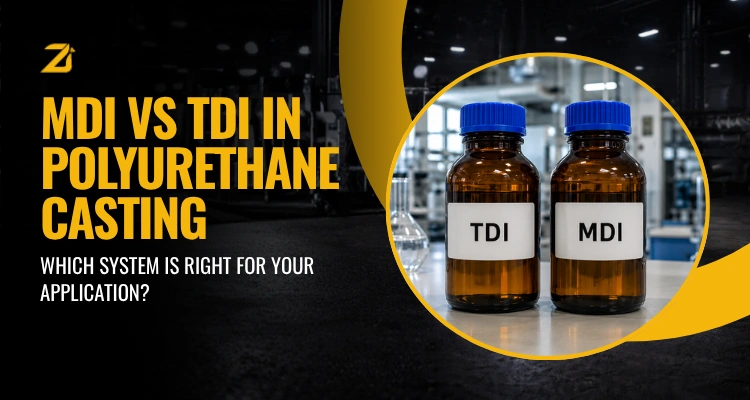
MDI (methylene diphenyl diisocyanate) and TDI (toluene diisocyanate) are the two most established isocyanate families used to cast wheels, rollers, seals, scrapers, pads, and bushings, and neither is universally better. The right system depends on the mechanical properties required, dynamic loading, operating environment, processing window, curative chemistry, production volume, and industrial hygiene requirements, not the oversimplified rule that MDI means hard and TDI means soft. Modern prepolymer families in both chemistries can be engineered across a wide property range.
Chemistry selection should also be weighed against the capabilities of the cast polyurethane elastomer solution that will meter, mix, control, and dispense the material.
Key Takeaways
- MDI is commonly selected for demanding cast elastomer applications where toughness, abrasion resistance, resilience, tear performance, chemical performance, or processing flexibility are important.
- TDI remains highly relevant in cast polyurethane elastomers, particularly where proven hot-cast processing, dynamic performance, resilience, and established formulations are required.
- MDI generally has lower vapor pressure than TDI, but both are reactive isocyanates requiring appropriate engineering controls, handling procedures, PPE, and ventilation.
- The isocyanate alone does not determine performance. Polyester vs polyether backbone, prepolymer architecture, curative, NCO content, catalyst, hardness, and post-cure conditions all influence the finished component.
- Selecting the chemistry and selecting the polyurethane metering, mixing, and dispensing system should be treated as connected engineering decisions.
What are MDI and TDI in Polyurethane Casting?
Polyurethane is produced through reactions involving polyols and isocyanates. MDI and TDI are two widely used aromatic diisocyanate families used across polyurethane chemistry.
For industrial casting, manufacturers commonly work with prepolymer systems rather than considering only the raw diisocyanate.
A polyurethane prepolymer is created by partially reacting an isocyanate with a polyol. During casting, that prepolymer is subsequently reacted with a compatible curative or chain extender to form the finished elastomer.
This distinction matters.
A TDI-polyester system, TDI-polyether system, MDI-polyester system, and MDI-polyether system can behave quite differently even though two of them share the same isocyanate family. BASF, for example, lists commercial hot and cold cast systems using MDI and TDI with polyester, polyether, and polycaprolactone polyols.
Therefore, an engineering comparison should evaluate the complete polyurethane system, not just MDI versus TDI as isolated chemicals.
MDI vs TDI Polyurethane: Quick Comparison
| Selection Factor | MDI-Based System | TDI-Based System |
|---|---|---|
| Cast elastomer suitability | Excellent | Excellent |
| Typical processing | Hot cast and other formulated systems | Well-established hot cast systems |
| Mechanical property range | Very broad | Very broad |
| Abrasion resistance | Can be excellent | Can be excellent |
| Resilience | Can be excellent | Often strong, formulation dependent |
| Load-bearing performance | Strong options available | Strong options available |
| Processing window | Formulation dependent | Formulation dependent |
| Vapor exposure potential | Generally lower at monomer level | Generally higher at monomer level |
| Curative options | Alcohol and amine-based options available | Traditional and modern curative options available |
| Low-free-monomer technology | Available | Available |
| Polyester/polyether compatibility | Both available | Both available |
| Best choice | Depends on service and production requirements | Depends on service and production requirements |
How Do MDI and TDI Differ in Polyurethane Casting?
1. Mechanical Performance
Mechanical performance is usually the first consideration when selecting a polyurethane elastomer, but it should not be reduced to one property.
Depending on formulation, engineers may need to optimize:
- Tensile strength
- Tear and cut resistance
- Abrasion resistance
- Elongation
- Rebound
- Compression set
- Load-bearing capacity
- Heat build-up
- Impact resistance
- Fatigue behavior
MDI-based cast systems are available with excellent mechanical and chemical properties, including high resilience, tear resistance, and abrasion resistance. TDI-based systems are also used for demanding elastomer applications requiring toughness, load-bearing performance, cut resistance, abrasion resistance, and resistance to heat build-up.
Engineering implication: Do not specify "MDI" or "TDI" based on strength alone. Define the actual mechanical property targets first.
2. Dynamic Loading and Resilience
Components such as forklift wheels, industrial rollers, shock-control components, couplings, and material-handling parts repeatedly deform under load.
For these applications, engineers need to consider more than static tensile strength. Rebound, hysteresis, heat build-up, compression behavior, fatigue life, and load frequency can become more important.
TDI technologies have a long history in high-performance cast elastomers, and modern low-free TDI prepolymers are marketed specifically for strong dynamic performance and processing characteristics.
MDI systems can also deliver high resilience and demanding mechanical performance, particularly when the complete prepolymer and curative package is designed around the application.
The decision therefore needs to be made using actual dynamic requirements, not an assumption that one isocyanate automatically wins.
3. Polyester vs Polyether Can Matter as Much as MDI vs TDI
One of the biggest mistakes in polyurethane material selection is focusing exclusively on the isocyanate.
The polyol backbone can materially change elastomer behavior.
Polyester-based polyurethanes are frequently selected where strong mechanical properties and resistance to oils or solvents are priorities. Polyether-based polyurethanes are often considered where hydrolytic stability, resilience, or low-temperature performance becomes important.
That gives engineers combinations such as:
- MDI + polyester
- MDI + polyether
- TDI + polyester
- TDI + polyether
Commercial suppliers offer both ester- and ether-based MDI and TDI technologies, which demonstrates why a simple two-column MDI/TDI decision can be misleading.
For wet environments, high cyclic loading, aggressive abrasion, oil contact, or temperature extremes, evaluate the entire polymer architecture.
4. Processing, Flow and Pot Life
In production, the technically strongest formulation is useless if it cannot be cast consistently.
Important processing parameters include:
- Component viscosity
- Material temperature
- Mixing ratio
- Pot life
- Mold-filling time
- Degassing requirement
- Reaction profile
- Demolding time
- Post-cure cycle
Modern MDI systems can provide good flow characteristics and adjustable pot life, while TDI systems remain widely used in established hot-cast polyurethane operations.
Low-free technology further complicates blanket comparisons. UBE reports that low-free TDI prepolymers can provide lower process viscosity, longer pour life, easier mixing, reduced bubble entrapment, and faster demolding compared with conventional prepolymers in its product family.
This illustrates an important rule:
CTA: Compare the actual material grades your plant intends to process, not only the letters MDI and TDI.
5. Curative Selection
The curative or chain extender is another major part of the casting system.
Traditional cast polyurethane manufacturing has often paired particular prepolymer families with established curatives. However, modern chemistry now offers multiple alternatives.
For example, Covestro documents MDI systems compatible with alcohol-based and amine-based crosslinkers and has developed MDI technologies partly in response to demand for alternatives to traditional MOCA-cured systems.
Low-free TDI systems and alternative curing technologies are also available.
Therefore, it is inaccurate to assume that all TDI requires one curative, or all MDI requires another.
When evaluating a system, consider:
- Recommended curative
- Curative processing temperature
- Mixing ratio
- Pot life
- Toxicological and regulatory requirements
- Required post-cure cycle
The required ratio, viscosity, flow, and reaction characteristics also influence the metering pump configuration needed to deliver each component accurately and consistently.
6. Industrial Hygiene and Isocyanate Exposure
This is one of the clearest differences between the two chemistries, but it still requires careful wording.
TDI generally has higher vapor pressure than MDI, increasing its potential to become airborne during handling. MDI's lower volatility can provide an industrial-hygiene advantage in certain processes.
However, MDI should never be described as harmless or inherently safe.
OSHA identifies both MDI and TDI as isocyanates requiring exposure control and notes that isocyanate exposure can cause respiratory sensitization, occupational asthma, irritation, and other health effects.
Modern low-free-monomer prepolymers can further reduce residual monomer levels. UBE, for example, offers low-free MDI and TDI technologies containing less than 0.1 wt% free diisocyanate in specified product families.
For production plants, appropriate controls may include closed material handling, extraction, ventilation, operator training, suitable PPE, spill procedures, and equipment designed to minimize unnecessary chemical exposure.
Which Applications Suit MDI or TDI?
| Application Requirement | What to Prioritize |
|---|---|
| Heavy-duty industrial wheel | Load capacity, rebound, heat build-up, abrasion |
| Steel or paper mill roller | Wear, dynamic loading, temperature, bonding |
| Mining screen or scraper | Abrasion, cut resistance, impact |
| Seal or gasket | Compression set, chemical resistance, flexibility |
| Bushing | Load, fatigue, deformation, lubrication environment |
| Marine component | Hydrolysis resistance, dynamic loading |
| Shock or impact component | Rebound, damping, tear strength |
| Large cast component | Pot life, mold flow, degassing, cure behavior |
Cast polyurethane suppliers use both MDI and TDI systems for applications including wheels, rollers, mining screens, scrapers, belting, seals, and other demanding elastomer components.
The correct question is therefore not:
"Are wheels MDI or TDI?"
It is:
"Which polyurethane formulation provides the required performance for this wheel's load, speed, temperature, environment, geometry, and expected service life?"
7 Questions to Ask Before Choosing an MDI or TDI Casting System
1. What actually causes the component to fail?
Is the dominant problem of abrasion, tearing, compression set, heat build-up, hydrolysis, chemical exposure, impact, or fatigue?
Start with the failure mechanism.
2. What hardness and mechanical properties are required?
Specify Shore hardness together with tensile, elongation, tear, rebound, compression, and abrasion requirements where relevant.
Hardness alone does not define polyurethane performance.
3. Is the application exposed to water, oil, or chemicals?
Environmental exposure can change whether polyester or polyether chemistry is suitable, which may be as important as choosing MDI or TDI.
4. What is the operating temperature and duty cycle?
Continuous dynamic loading generates internal heat differently from intermittent static loading. Assess real operating conditions instead of only maximum ambient temperature.
5. How large and complex is the mold?
Large components and narrow flow paths may require sufficient pour life, controlled viscosity, reliable degassing, and stable material temperature.
6. What are the plant's health, safety and curative requirements?
Evaluate residual monomer content, vapor control, ventilation, curative handling, regional regulations, and operator exposure alongside mechanical performance.
7. Can the existing dispensing equipment process the selected chemistry?
A material change can affect tank heating, pump selection, seals, line temperatures, metering ratios, mixer design, vacuum requirements, cleaning, controls, and changeover procedures.
Material selection and machine selection should happen together.
How Does MDI vs TDI Affect a Polyurethane Casting Machine?
Once the formulation is selected, repeatable production depends on controlling the conditions under which it is processed.
A polyurethane metering, mixing, and dispensing system typically needs to manage three functions:
Metering: Deliver each component at the required ratio.
Mixing: Homogenize reactive components before the reaction progresses too far.
Dispensing: Fill the mold at the required flow rate with minimal air entrapment and consistent shot control.
Zealot's polyurethane MMD systems are designed around controlled metering, material temperature, mixing, dispensing, and process repeatability for cast elastomer production. Its current system architecture also supports MDI/TDI processing requirements and variable-ratio applications.
When evaluating machinery for either chemistry, consider:
- Required component ratio and metering accuracy
- Material viscosity at processing temperature
- Heated tank and hose requirements
- Vacuum degassing
- Dynamic or static mixing requirement
- Pour rate
- Pot life
- Mold volume
- PLC/HMI recipe control
- Cleaning or flushing procedure
- Production capacity
- Future formulation changeovers
This becomes especially important for manufacturers producing several polyurethane products from one facility.
Common MDI vs TDI Selection Mistakes
Choosing by hardness alone
Both chemistry families can cover meaningful hardness ranges. Shore hardness should be treated as one specification among many.
Assuming every MDI formulation behaves the same
MDI-polyester and MDI-polyether systems can produce significantly different results.
Assuming TDI is only for foam
Although TDI is extensively used in flexible foam, established TDI prepolymers are also used in high-performance cast polyurethane elastomers.
Calling MDI "safe"
MDI's lower vapor pressure does not remove isocyanate hazards. Both chemistries require suitable industrial hygiene controls.
Selecting chemistry before considering production equipment
A formulation that performs well in laboratory testing must still be metered, mixed, degassed, poured, and cured consistently at production scale.
MDI or TDI: Which Should You Choose?
Choose neither based on reputation alone.
Begin with the finished component.
Define its:
- Load and duty cycle
- Hardness range
- Abrasion and tear requirements
- Rebound or damping requirement
- Compression behavior
- Operating temperature
- Water and chemical exposure
- Component geometry
- Production volume
- Processing and safety constraints
Then compare specific MDI and TDI formulations that meet those requirements.
For many manufacturers, the better long-term strategy is also to use polyurethane casting equipment capable of accommodating different material systems and processing recipes rather than designing production around one narrow formulation.
Zealot Inc. develops automatic and hand-batch cast polyurethane elastomer systems for controlled mixing, metering, dispensing, temperature management, and production repeatability. The company states 30+ years of polyurethane engineering experience and more than 100 machines delivered across 4+ countries.
Planning a new PU casting line or evaluating a change from TDI to MDI?
Discuss your formulation, component geometry, hardness range, batch size, output target, and processing requirements with Zealot before finalizing the equipment architecture.
Conclusion
Hard polyurethane elastomers occupy a well-defined engineering space between flexible rubber and rigid structural materials. When selected against the correct application criteria, they reduce wear rates, extend component service life, resist oils and chemicals that degrade rubber, and lower total maintenance cost in abrasive industrial environments.
The substitution logic is not universal. Elongation requirements, low-temperature flexibility, and continuous heat exposure determine whether rubber remains the correct choice. When abrasion resistance, load capacity, and oil resistance matter most, hard PU consistently outperforms rubber on a total cost of ownership basis across most industrial wear applications.
Zealot Inc. engineers and supplies cast polyurethane elastomer dispensing systems compatible with MDI and TDI chemistries, supporting hard PU industrial casting applications for buyers across India and international markets replacing rubber and metal components alike.
Frequently Asked Questions (FAQs)

Digvijaysingh Rao
Head of Sales & Strategy
Digvijaysingh Rao leads sales and business development at Zealot Inc. He works closely with customers to understand their production challenges and recommend solutions that are practical and easy to maintain.