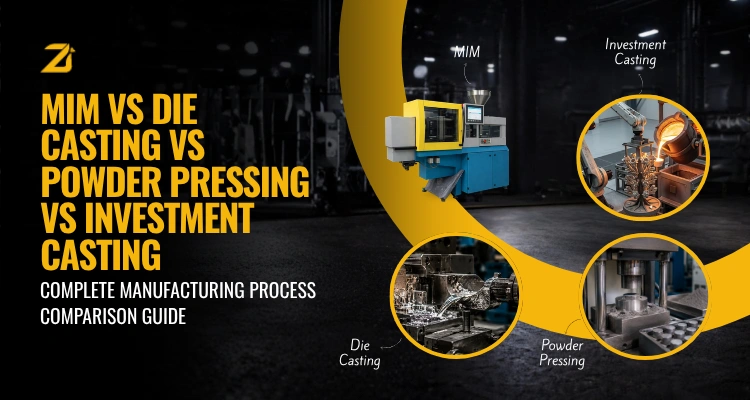
MIM vs Die Casting vs Powder Pressing vs Investment Casting: Complete Manufacturing Process Comparison Guide
 Digvijaysingh Rao
on
Digvijaysingh Rao
on
Introduction
Choosing between MIM vs die casting vs powder pressing vs investment casting can decide whether a component program hits its per-part cost target or blows past it once tooling is invoiced. All four processes turn metal into a near-net-shape part, but they get there through completely different physics, and each one rewards a different combination of part size, geometry, alloy, and production volume. Picking the wrong route usually shows up late: at first article inspection, at the tooling deposit, or in a re-quote after a prototype fails a tolerance check.
This guide compares all four processes on the criteria that actually drive a sourcing decision: tolerance, surface finish, achievable density, part weight, material options, and cost at volume. Use it to shortlist the right process before an RFQ goes out.
Key Takeaways
- MIM fits small, complex parts under about 250 grams that need high density and fine tolerance at high production volume.
- Die casting is fast and low-cost per part but limited to non-ferrous alloys and prone to internal gas porosity.
- Powder pressing is the most economical route for simple, mostly two-dimensional ferrous shapes at moderate to high volume.
- Investment casting spans the broadest alloy and part-size range of the four and stays viable at lower production volumes than the others.
- Tighter tolerance and higher part precision generally mean higher tooling cost, not lower cost overall.
- The right process depends on part weight, required alloy, geometry, and committed annual volume, not on tolerance alone.
- A DFM review before tooling is cut catches shrinkage, draft, and wall-thickness issues that a machining-based drawing will miss.
Quick Comparison: MIM vs Die Casting vs Powder Pressing vs Investment Casting
| Factor | MIM | Die Casting | Powder Pressing | Investment Casting |
| Typical part weight | 0.1 g to 250 g | 30 g to 10 kg+ | 1 g to 4 kg | 15 g to 25 kg+ |
| Typical tolerance | ±0.3 to ±0.5% of dimension | ±0.1 to ±0.2 mm | ±0.05 to ±0.1 mm | ±0.13 to ±0.4 mm per 25 mm |
| As-produced surface finish | Ra 0.8 to 1.6 µm | Ra 0.8 to 3.2 µm | Ra 1.6 to 3.2 µm | Ra 3.2 to 6.3 µm |
| Achievable density | Above 97% theoretical | Near full, gas porosity common | 85 to 93% (up to 99% with double press) | Fully dense, minimal porosity |
| Geometric complexity | Highest for small parts, fine features, undercuts | Good, limited by draft and porosity | Mostly 2D, axisymmetric shapes | High, including internal passages via cores |
| Material range | Stainless, tool, and low alloy steels, titanium, tungsten alloys | Aluminum, zinc, magnesium, copper alloys | Iron, carbon steel, copper, stainless steel | Broadest: carbon and stainless steels, superalloys, non-ferrous alloys |
| Economical volume | 10,000+ units a year, lower for high-value small parts | 10,000 to 50,000+ units a year | 5,000 to 10,000+ units a year | Viable from low volumes up to high volumes |
What Is Metal Injection Molding (MIM)?
Metal injection molding combines the design freedom of plastic injection molding with the strength of fully dense sintered metal. Fine metal powder, typically under 22 microns, is blended with a polymer and wax binder system to form a moldable feedstock. That feedstock is injected into a precision mold cavity to form a green part, which then goes through debinding to remove the binder and sintering at high temperature to fuse the metal particles into a dense, near-net-shape component.
MIM parts shrink by roughly 15 to 20% during sintering, so mold design has to compensate for that shrinkage in advance. In exchange for that engineering effort, MIM produces some of the most intricate small metal components achievable through any molding process, including thin walls, undercuts, threads, and internal features that would be difficult or impossible to machine economically.
MIM works with a wide alloy range, including 316L and 17-4 PH stainless steel, low alloy steels, tool steels, titanium, and tungsten heavy alloys, which makes it a common choice for surgical instruments, firearm trigger and safety-lever mechanisms, orthodontic brackets, connectors, and small structural brackets in aerospace and consumer electronics.
What Is Die Casting?
Die casting forces molten metal into a hardened steel die under high pressure, typically 10 to 175 MPa, where it solidifies in seconds. Because it works with molten metal rather than powder, die casting is restricted to non-ferrous alloys with comparatively low melting points, primarily aluminum, zinc, and magnesium, with copper-based alloys used less frequently.
The process is fast. Cycle times often run under a minute, which makes die casting one of the most productive routes for medium to large metal parts at high volume. Standard high-pressure die casting (HPDC) holds tolerances around ±0.1 to ±0.2 mm on critical dimensions under ISO 8062-3 and NADCA tolerance grades, with as-cast surface finishes as smooth as Ra 0.8 µm on well-maintained tooling.
The trade-off is porosity. The turbulent, high-velocity fill that makes die casting fast also traps gas inside the part, which is why standard die castings are generally not recommended for pressure-tight sealing surfaces or for parts that need post-cast heat treatment, unless a vacuum-assisted variant is specified.
What Is Powder Pressing (Conventional Powder Metallurgy)?
Powder pressing, also called press-and-sinter or conventional powder metallurgy, compacts metal powder directly in a rigid die at pressures between roughly 140 and 965 MPa, then sinters the resulting green compact in a controlled-atmosphere furnace. Unlike MIM, there is no binder system and no debinding step, which keeps the process cycle short and the per-part cost low at volume.
Because compaction is a uniaxial, single-stroke operation, powder pressing is best suited to parts with a consistent cross-section, such as gears, bushings, cams, and structural brackets. Lateral holes, undercuts, and reverse tapers cannot be formed in the pressing step and need secondary machining if required. Standard press-and-sinter parts reach 85 to 93% of theoretical density, with double-press double-sinter processing pushing density toward 95 to 99% for applications where fatigue strength matters more than tooling cost.
Powder pressing is almost always the lowest-cost route per part once volume clears the tooling break-even point, which is why it remains the workhorse process for ferrous structural components across automotive and general industrial manufacturing.
What Is Investment Casting?
Investment casting, also known as lost wax casting, is one of the oldest near-net-shape metal manufacturing processes still in industrial use. A wax pattern is injected from a metal die, then dipped repeatedly in ceramic slurry to build a shell mold. The wax is melted out in an autoclave, leaving a ceramic cavity that molten metal is poured into. Once the metal solidifies, the ceramic shell is broken away to reveal the casting.
Investment casting has the broadest material range of the four processes covered here, because it works with any alloy that can be melted and poured, including carbon and stainless steels, superalloys, and non-ferrous metals. It also covers the widest span of part sizes, from small brackets under 50 grams up to large structural castings measured in tens of kilograms.
The trade-off against MIM is tolerance and surface finish. Investment casting typically holds tolerances of roughly ±0.13 to ±0.4 mm per 25 mm of dimension, looser than MIM, and an as-cast surface finish around Ra 3.2 to 6.3 µm, which often calls for secondary finishing on cosmetic or sealing surfaces.
Full Technical Comparison: Tolerance, Surface Finish, and Density
| Specification | MIM | Die Casting | Powder Pressing | Investment Casting |
| Feedstock or raw material state | Metal powder plus polymer binder | Molten metal | Loose metal powder plus lubricant | Molten metal |
| Forming pressure | 5 to 20 MPa (injection) | 10 to 175 MPa (injection) | 140 to 965 MPa (compaction) | Gravity or low-pressure pour |
| Process steps | Mixing, injection, debinding, sintering | Melt, inject, solidify, trim | Blend, compact, sinter | Wax pattern, shell build, dewax, pour, shell removal |
| Typical wall thickness | 0.3 mm and above | 0.5 mm and above (aluminum), thinner in zinc | Governed by press design, not wall-limited in the same sense | 1.5 mm and above, thinner with careful gating |
| Post-sinter or post-cast shrinkage | 15 to 20% linear | Negligible (solidification shrinkage compensated in die design) | Minimal, controlled by compaction pressure | Alloy-dependent, compensated in wax pattern die |
| Typical secondary operations | CMM inspection, passivation, light machining, coining | Trimming, CNC machining, plating, powder coating | Sizing, coining, oil impregnation, light machining | Cutoff from tree, grinding, CNC machining, heat treatment |
How to Choose the Right Process for Your Part
Four questions narrow the shortlist faster than any single spec sheet comparison.
What does the part weigh, and how big is it?
Under roughly 250 grams with fine detail, MIM is usually the strongest fit. Between 30 grams and several kilograms with simpler wall geometry, die casting or powder pressing both come into play depending on alloy. Above a few kilograms, or for large structural shapes, investment casting or die casting take over.
What alloy does the application require?
Die casting is locked into non-ferrous, low-melting-point metals. If the part needs a ferrous alloy, tool steel, titanium, or a high-temperature material, that alone rules out die casting and points toward MIM, powder pressing, or investment casting.
How complex is geometry?
Powder pressing works best on parts that are essentially 2D in cross-section. MIM and investment casting both handle undercuts and internal features, with MIM generally holding tighter tolerances at small sizes and investment casting scaling better to larger, more intricate shapes.
What volume are you committing to?
Tooling costs have to be amortized somewhere. Powder pressing and MIM both need meaningful annual volume, typically several thousand units and up, to justify tooling investment. Investment casting is the most forgiving of the four at low to moderate volumes because wax injection tooling is comparatively inexpensive.
Industry Applications: Which Process Fits Which Sector
Medical and surgical
Surgical instrument jaws, orthodontic brackets, and implant components favor MIM for its combination of high density, biocompatible stainless and titanium alloys, and repeatable small-feature accuracy.
Automotive
Turbocharger sensor housings and small locking mechanisms often go to MIM for complexity and density, while structural brackets and housings that tolerate looser tolerances commonly run through die casting or powder pressing at higher volume.
Aerospace and defense
Lightweight precision brackets and small turbine hardware frequently use MIM for tolerance and material strength, while trigger and safety-lever mechanisms in firearms manufacturing are a well-established MIM application for the same reasons.
Consumer electronics
Hinges, SIM trays, and connectors are classic MIM parts, chosen for their combination of small size, tight tolerance, and high production volume.
General industrial
Gears, bushings, cams, and structural components across conveyor, agricultural, and general machinery applications are a natural fit for powder pressing, where cost per part matters more than fine surface detail.
Cost Comparison: Tooling, Per-Part Cost, and Break-Even Volume
| Process | Typical tooling investment | Cost driver at volume | Practical break-even |
| Investment casting | Roughly ₹40,000 to ₹4 lakh for a wax injection die | Labor-intensive shell building and finishing | Viable from small batches through high volume |
| Powder pressing | Roughly ₹4 lakh to ₹40 lakh for a compaction die set | Powder and lubricant cost, press rate | Economical above approximately 5,000 to 10,000 units a year |
| MIM | Roughly ₹2 lakh to ₹4 lakh for an injection mold | Metal powder cost, debind and sinter cycle time | Economical above approximately 10,000 units a year, lower for high-value small parts |
| Die casting | Roughly ₹25 lakh to ₹4 crore or more for a hardened steel die | Melt energy, die maintenance, cycle time | Strongest economics above approximately 100,000 units a year |
Common Mistakes When Choosing a Metal Manufacturing Process
Assuming die casting can run stainless steel or tool steel
Die casting is limited to alloys with low melting points. Ferrous and high-temperature alloys need MIM, powder pressing, or investment casting instead.
Specifying MIM-level tolerances on an investment casting drawing
Wax pattern shrinkage and ceramic shell variability mean investment casting tolerances are inherently wider than MIM. Tightening the drawing without changing the process just adds rework and cost.
Treating die cast parts as heat-treatable or pressure-tight by default
Standard HPDC traps gas porosity that can cause blistering during heat treatment and leak paths in pressure-tight applications, unless a vacuum-assisted process is specified upfront.
Assuming MIM is always the cheapest option
MIM tooling and powder cost only pay for themselves at volume. For large parts, low volumes, or simple 2D shapes, powder pressing or investment casting is usually the more economical route.
Skipping a DFM review before tooling is cut
Every one of these four processes carries a shrinkage factor, a draft requirement, or a wall thickness rule that a drawing built for machining will not automatically satisfy. A DFM pass before the first article inspection prevents a costly second tooling cycle.
Why Manufacturers Partner with Zealot for MIM
Zealot Inc. delivers metal injection molded (MIM) components alongside its polyurethane and cast nylon dispensing systems business. Zealot has supplied precision components and machinery for more than 30 years, works across Defense, Automotive, Electrical and Electronics, Medical and Surgical, Textile, and Aerospace sectors, and exports to the Middle East, Europe, USA, Australia, and Germany.
What sets the MIM offering apart is context. Because the same engineering group also builds turnkey production plants and material dispensing systems, a DFM conversation with Zealot covers material selection, feedstock behavior, and secondary finishing in one place rather than across multiple vendors. Every MIM program starts with a 360-degree consultation, from feasibility review through first article inspection, so a component decision that starts with a question like "MIM vs die casting" ends with a manufacturable part, not just a process recommendation.
Frequently Asked Questions (FAQs)
Read More:
- Metal Injection Molding Cost in India: When MIM Becomes More Cost-Effective Than Machining, Casting, and CNC Manufacturing
- What Parts Can Be Made with Metal Injection Molding (MIM)? Across 8 Key Industries
- Metal Injection Molding (MIM) Design Guidelines: Complete DFM Guide
- The MIM Process Step by Step: From Metal Powder to Precision Component

Digvijaysingh Rao
Head of Sales & Strategy
Digvijaysingh Rao leads sales and business development at Zealot Inc. He works closely with customers to understand their production challenges and recommend solutions that are practical and easy to maintain.