Cast Nylon Applications in India: 8 Industries That Rely on MC Nylon Components for High Performance
 Digvijaysingh Rao
on
Digvijaysingh Rao
on
Key Takeaways
MC Nylon, or Monomer Cast Nylon, is produced through anionic polymerization of caprolactam in open or closed molds at atmospheric pressure. This casting process produces a polymer with a molecular weight exceeding 100,000 g/mol, compared to 20,000 to 30,000 g/mol for injection-molded polyamide 6. The higher molecular weight translates directly into superior tensile strength, wear resistance, and dimensional stability under sustained mechanical load.
In Indian industrial environments, bronze bushings corrode in humid and wet process conditions. Mild steel components pit and seize in abrasive slurry contact. Rubber guides harden and crack under continuous UV and thermal cycling. MC Nylon replaces all three materials in the specific operating conditions where their failure mechanisms are most costly, which is why plant maintenance teams across mining, textiles, steel, and food processing have adopted it at scale over the past fifteen years.
The cost case is straightforward. An MC Nylon bushing machined from cast rod stock costs a fraction of a bronze equivalent and lasts comparably or longer in dry and semi-lubricated service. When the labour and downtime cost of frequent replacement is included in the calculation, the lifetime cost advantage of MC Nylon in high-cycle, moderate-to-heavy load applications is substantial for Indian plants operating on compressed maintenance budgets.
Key Takeaways
- MC Nylon delivers a tensile strength of 70 to 100 MPa and a friction coefficient of 0.1 to 0.3, combining structural capacity with self-lubricating behaviour in a single material.
- The self-lubricating property of cast nylon eliminates external greasing requirements in many bearing and bushing applications, reducing maintenance labour and contamination risk.
- Wear resistance of MC Nylon is 10 times higher than standard injection-molded PA6 under equivalent contact conditions, extending component life in continuous-duty applications.
- At a density of approximately 1.16 g/cm3, MC Nylon components weigh 85 percent less than equivalent bronze and 86 percent less than steel, reducing load on drive systems and structural supports.
- Lifecycle cost per operating hour is lower than metal alternatives in friction-heavy, corrosion-prone, and abrasion-active environments despite requiring no special surface treatment or lubrication.
1. Mining and Mineral Processing: Hydrocyclone Liners, Screens, and Wear Pads
Indian mining operations handling iron ore in Karnataka, coal in Jharkhand, and bauxite in Odisha run slurry circuits continuously, with particle sizes and flow velocities that destroy conventional metal and rubber linings within months. Hydrocyclones, vibrating screen decks, chute liners, and impact wear pads in these circuits require materials that resist simultaneous abrasion, impact, and wet chemical exposure.
MC Nylon components in the appropriate grade outperform mild steel and cast iron in fine particle slurry abrasion because the polymer surface deflects and recovers under particle impact rather than fracturing or developing micro-cracks at the wear face. Hydrocyclone inlet liners and apex sections cast in MC Nylon typically achieve 2 to 3 times the service life of equivalent steel parts in fine ore slurry applications, with the additional benefit of lower total component weight that simplifies site handling and replacement.
For Indian mineral processing engineers, the maintenance interval advantage translates directly into fewer planned shutdowns per year and higher effective plant utilization. Where a steel liner requires quarterly replacement, an MC Nylon equivalent on the same circuit may operate for six to nine months before planned exchange.
Zealot's cast nylon capability covers custom-profile liner sections and wear pad geometries machined from cast rod and sheet stock to site-specific dimensions.
2. Textile Machinery: Guides, Gears, and Rollers
India's textile manufacturing sector, concentrated in Gujarat, Tamil Nadu, Maharashtra, and Rajasthan, runs weaving looms, spinning frames, and processing machinery at high speeds and continuous duty cycles. Yarn guides, traverse gears, roller bushings, and guide pins in textile machinery must maintain dimensional accuracy under high-cycle loading with minimal maintenance intervention.
Bronze gears and guides in textile machinery require periodic lubrication. In yarn-contact applications, lubricant contamination causes rejects and increases cleaning downtime. MC Nylon gears and guides operate dry, eliminating lubricant contact with yarn and reducing housekeeping requirements. The material's low friction coefficient against steel mating surfaces reduces wear on both components, extending the maintenance interval for gear trains and drive assemblies.
Dimensional stability under humidity variation is a specific requirement in Indian textile plants where ambient conditions vary significantly across seasons. MC Nylon absorbs between 0.5 and 1.5 percent moisture by weight at saturation, compared to 2.5 to 3.5 percent for standard PA6. This lower water absorption rate maintains gear tooth profile accuracy and guide bore dimensions through humid monsoon conditions and dry winter operating periods.
3. Conveyor and Material Handling: Idler Rollers, Chain Guides, and Drive Pulleys
Belt conveyors in Indian cement plants, power stations, port bulk handling terminals, and food processing facilities run millions of cycles per year. Idler rollers, chain guides, and drive pulley lagging in these systems face continuous abrasion from product contact, impact from lumpy material, and in outdoor installations, UV and moisture degradation.
MC Nylon idler rollers and chain guides reduce the friction load on conveyor drive systems compared to steel equivalents because of the material's low coefficient of friction against belt backing and chain link surfaces. In long conveyor systems, this friction reduction measurably reduces motor load and energy consumption per tonne of material conveyed, a factor that is increasingly relevant to Indian plant energy cost management.
Chain guides and wear strips in MC Nylon resist the point-contact abrasion of chain link edges without requiring lubrication on the guide surface itself. In food-grade conveyor applications, this eliminates a contamination source. In cement and mineral handling, it removes a maintenance task from shift routines.
Zealot supplies cast nylon components for conveyor system applications including custom-profile wear strips, guide channel sections, and pulley bushings machined to conveyor manufacturer specifications.
4. Steel Plants: Roller Covers, Bushings, and Wear Plates
Integrated steel plants and secondary rolling mills in India operate continuous casting lines, hot rolling mills, and material handling systems under sustained thermal and mechanical loads. Bronze and babbitt metal bushings in rolling mill guide assemblies require regular grease replenishment and are susceptible to seizure if lubrication intervals are missed under the demanding operating pace of continuous production.
MC Nylon bushings in rolling mill side guides and entry guide assemblies operate at the load and speed conditions of hot strip finishing lines when positioned away from direct radiant heat zones. They eliminate grease nipple maintenance, resist the mill scale abrasion that erodes soft metal bearing surfaces, and can be replaced without precision fitting because standard bore and shaft tolerances accommodate the material's slight compressibility under load.
Wear plates and slide pads in steel plant transfer car systems, tundish slide gates, and ladle transfer equipment made from MC Nylon provide low-friction sliding surfaces that reduce actuator force requirements and protect structural steel contact faces from scoring. The material's resistance to the alkaline process water and descaling chemicals used in hot strip mills extends service life compared to rubber or UHMWPE alternatives in the same applications.
5. Chemical Processing: Bearings and Pump Parts That Will Not Corrode
Chemical manufacturing and process industries in India, including Gujarat's petrochemical cluster and the fertilizer plants across coastal manufacturing zones, require bearing and pump components that resist chemical attack across a broad range of process media. Bronze corrodes in acid and chloride environments. Standard carbon steel requires coating or constant replacement. Stainless steel is expensive and difficult to machine for small-volume replacement parts.
MC Nylon resists dilute acids, alkalis, hydrocarbons, and most organic solvents at moderate concentrations and temperatures up to 110°C in continuous service. Pump impeller guide bushings, agitator shaft bearings, valve stem bushings, and filter press component guides cast in MC Nylon maintain dimensional accuracy in chemically aggressive wet environments without surface treatment or protective coating.
For Indian chemical plant procurement managers, the total cost advantage of MC Nylon over stainless steel for medium-duty bearing and guide applications is significant. Machining time and raw material cost per part are both lower, and service life in corrosive wet service is comparable or longer than stainless in applications where mechanical load rather than corrosion governs component life.
6. Food Processing: FDA-Compliant Conveyor and Machine Components
India's food processing sector, covering dairy, edible oil refining, flour milling, beverage production, and packaged food manufacturing, operates under food safety regulatory frameworks that restrict material selection for components in contact with or near food products. Lubricated bronze and cast iron components present contamination risks. Standard industrial polymers may not comply with food contact material requirements.
Food-grade MC Nylon formulations comply with applicable food contact standards and are used in conveyor chain guides, star wheels, filler machine bushings, and packaging line rollers in Indian food manufacturing plants. The material does not require external lubrication in most food processing contact applications, eliminating a contamination pathway that creates both food safety risk and cleaning burden.
Moisture resistance is particularly relevant in Indian dairy and beverage plant environments where equipment undergoes daily high-pressure hot water washdown. MC Nylon's low moisture absorption and retention of mechanical properties after repeated wet-dry cycling makes it more dimensionally stable in washdown environments than many competing engineering polymers that absorb and swell under sustained water exposure.
7. Construction and Infrastructure: Sliding Plates, Guides, and Seals
India's construction and infrastructure sector spans concrete production, aggregate processing, bridge and structural bearing systems, and slurry pipeline networks serving irrigation and mining distribution infrastructure. In these environments, components face dust-laden abrasion, outdoor UV exposure, and in bridge bearing applications, sustained compressive load combined with thermal expansion movement.
MC Nylon bridge bearing slide pads and expansion joint guides provide low-friction sliding surfaces between structural steel elements with higher load capacity per unit area than PTFE pads and better dimensional stability under sustained compression than rubber bearing pads. In aggregate screening and crushing plant dust environments, MC Nylon guide rails and hopper liner sections outperform steel by resisting the micro-abrasion of fine silica dust that scores and pits bare metal surfaces over time.
For civil construction material selection, the combination of UV resistance, adequate outdoor dimensional stability, and machinability to site-specific profiles makes MC Nylon cast rod and sheet a practical replacement for bronze in slide bearing applications where corrosion of the metal alternative creates long-term maintenance obligations in structures with design lives of 20 to 50 years.
8. Automotive OEM: Bushings, Pulleys, and Structural Inserts
India's automotive manufacturing base serves both domestic OEM production and an export supply chain that requires consistent dimensional performance across high-volume part runs. Suspension bushings, idler pulley bearings, timing belt guide inserts, and seat mechanism components produced in MC Nylon must meet dimensional tolerances across temperature cycles from sub-zero winter storage through engine bay operating temperatures.
MC Nylon outperforms injection-molded polyamide in these applications because the higher molecular weight of the cast material maintains mechanical strength under the sustained load and vibration cycles of vehicle service. Suspension guide bushings in MC Nylon provide the friction coefficient required for controlled movement without stick-slip behaviour, which is a common failure mode in rubber-based bushings at the end of their service life.
For Indian automotive Tier-2 and Tier-3 suppliers, MC Nylon's machinability from standard rod and tube stock enables prototype and low-volume production of bushing and pulley components without investment in injection mold tooling, reducing development cost and lead time for new model applications.
Zealot's engineering consultation team supports automotive suppliers with material selection, dimensional specification, and application review for MC Nylon components at both development and production stages.
Conclusion
MC Nylon has established itself as a technically superior replacement for bronze, mild steel, and standard injection-molded polymers in the specific operating conditions that dominate Indian industrial environments: abrasive wear, corrosive process media, high-cycle dry friction, and sustained mechanical load in intermittently maintained plant systems.
The eight industry segments covered here share a common engineering logic. Each faces a maintenance-driven cost pressure where the frequency of component replacement, the labour associated with lubrication or protective treatment, or the downtime cost of unexpected failure makes a higher-performance material economically justified even at a higher unit price. MC Nylon satisfies all three criteria simultaneously in most of these applications.
Material selection requires matching grade, geometry, and operating environment to the specific wear mechanism and load condition of each application. Natural MC Nylon, oil-filled MC Nylon, MoS2-modified MC Nylon, and glass-filled grades each address different combinations of friction, load, temperature, and chemical exposure. Selecting the wrong grade, even of the right base material, produces premature failure and undermines the lifecycle cost case.
Zealot's engineering team conducts application-specific reviews for MC Nylon component selection, covering load conditions, friction requirements, chemical exposure, operating temperature, and dimensional specification before recommending grade and form.
Frequently Asked Questions (FAQs)
Read More:
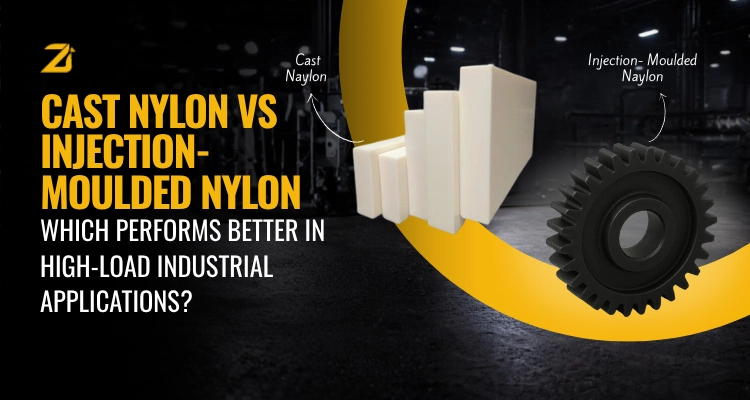
- Cast Nylon vs Injection-Moulded Nylon: Which Performs Better in High-Load Industrial Applications?
- How Cast Nylon Is Made: The Anionic Polymerization Process Explained Simply
- What is Cast Nylon (MC Nylon)? Complete Guide for Manufacturers
- MIM vs CNC Machining: When Metal Injection Molding Wins on Cost, Complexity & Volume

Digvijaysingh Rao
Head of Sales & Strategy
Digvijaysingh Rao leads sales and business development at Zealot Inc. He works closely with customers to understand their production challenges and recommend solutions that are practical and easy to maintain.