Cast Nylon Manufacturing Cost: In-House Production vs Outsourcing MC Nylon Components
 Digvijaysingh Rao
on
Digvijaysingh Rao
on
Introduction
A quotation for outsourced cast nylon components rarely settles the make-or-buy question on its own. A price per part may look simple, but it does not always show how volume, tooling, lead time, inspection and secondary machining affect the total cost.
This matters particularly for manufacturers of gears, bearing blocks, wear liners and other MC nylon components who are planning recurring production. The decision influences unit cost, delivery control and how much process knowledge remains within the company.
This guide explains the main cast nylon manufacturing cost drivers, compares in-house production with outsourcing and provides a practical framework for selecting the right route.
Key Takeaways
- Cost Depends on Volume: In-house production carries fixed costs that are spread across output, while outsourced prices may decrease at higher order quantities.
- Both Routes Have Multiple Costs: Material, tooling, processing, finishing and inspection affect both options, although ownership and supplier-related costs differ.
- Break-Even Volume Matters: Manufacturers should calculate when in-house production becomes less expensive than outsourcing instead of assuming a standard volume threshold.
- Control and Flexibility Differ: In-house production provides more direct process control, while outsourcing reduces capital investment and accommodates variable demand.
- In-House Production Requires Utilization: Recurring production is normally needed to justify equipment, training and facility costs.
- A Phased Approach Can Reduce Risk: Initial quantities may be outsourced before production is moved in-house after demand becomes stable.
What Actually Drives Cast Nylon Manufacturing Cost?
Cast nylon manufacturing cost is made up of several process stages. These costs exist whether a component is cast internally or produced by an outside supplier.
Material Cost
Material cost includes the caprolactam monomer, catalyst, activator and any additives required for the selected formulation. Consumption depends on casting mass, machining allowance, process losses and material grade.
Tooling and Mold Cost
Cast nylon molds do not need to withstand the high clamping and injection pressures associated with injection molding. However, they still need to be designed, manufactured, prepared and maintained.
Tooling cost depends on mold material, component geometry, size, production quantity and dimensional requirements.
Processing Time
Processing can include material preparation, catalyst and activator dosing, mixing, pouring, in-mold polymerization, demolding, cooling, conditioning and any required annealing.
Part geometry, section thickness, mold design and post-treatment requirements influence the production time for each acceptable component.
Secondary Operations
Machining, drilling and surface finishing add cost after casting. Cast nylon stock shapes and precision parts are often produced with machining allowance, while near-net-shape castings may require only limited finishing.
Inspection, Rework and Scrap
Dimensional inspection, visual checks, rejected parts and rework all affect the cost per accepted component. Calculating only the cost per part cast can therefore underestimate the actual production cost.
Other costs differ between the two routes. In-house production involves equipment maintenance, operator training and downtime, while outsourcing introduces supplier margin, logistics, inventory and vendor-management costs.
Where Cast Nylon Fits Against Stock Machining, Injection Molding and Metals
Cast nylon may be compared with machining components from nylon stock, using bronze or steel parts or manufacturing components through injection molding.
Compared with machining from cast or extruded nylon stock, near-net-shape casting can reduce the amount of material removed during finishing. This advantage is especially relevant for larger or complex components where substantial stock would otherwise be machined away.
Compared with suitable metal components, cast nylon can reduce weight, resist corrosion and require less external lubrication in appropriate bearing and wear applications. However, performance depends on the nylon grade, load, speed, temperature, mating surface and operating environment. Metal may still be necessary for very high loads or temperatures.
Injection molding generally involves more expensive, high-pressure tooling. It often becomes economical when production volume can justify that investment. Monomer casting may be more practical for larger, thicker or lower-to-medium-volume components, depending on their geometry and tolerance requirements.
Once cast nylon has been selected as the appropriate material, the manufacturer must determine whether internal production or outsourcing provides the more economical and reliable route.
Outsourcing MC Nylon Components: Cost Structure
Outsourcing shifts the casting-equipment investment to a job-work supplier and converts most manufacturing expenditure into a per-part or per-order price.
It avoids direct investment in an internal casting line, although tooling, development, initial samples, validation and minimum order quantities can still create upfront costs.
The supplier’s price generally includes material, processing, labor, overhead and margin. Tooling, inspection, freight and secondary machining may be included or charged separately. Unit pricing may also decrease at higher quantities because setup and tooling costs are distributed across more parts.
Outsourcing is suitable for initial production, low or variable demand and parts that are not central to the manufacturer’s operations.
The main trade-off is reduced control over production. Material preparation, dosing, moisture control, mold temperature, polymerization, annealing, machining and inspection can vary between suppliers. Delivery time also depends on the supplier’s available capacity and production queue.
For Indian manufacturers, overseas quotations should be assessed after adding freight, duties, order quantities and replenishment time. A domestic supplier may offer simpler logistics, but every option should be evaluated using actual commercial and technical terms.
In-House vs Outsourced: Cost and Control Comparison
| Factor | In-House Production | Outsourcing |
| Capital Investment | Equipment, tooling, facility preparation, training and validation | No equipment investment, but tooling and development charges may apply |
| Cost at Higher Volume | Fixed cost per accepted part falls as utilization increases | Unit price may decrease but continues to include supplier margin |
| Lead-Time Control | Managed according to internal capacity and material availability | Depends on supplier capacity, production queue and logistics |
| Process Control | Direct control with ongoing process monitoring | Requirements managed through specifications and supplier agreements |
| Tooling Ownership | Normally owned and reused internally | Ownership and amortisation should be defined contractually |
| Quality Consistency | Directly managed through validated internal controls | Depends on supplier controls, inspection and batch discipline |
| Best Suited For | Recurring, application-specific and higher-volume parts | Prototypes, variable volumes and non-core components |
When Does In-House Production Pay Off?
Break-even volume estimates the quantity at which the cost of establishing internal capacity is offset by savings against outsourcing.
A simplified calculation is:
Break-Even Volume = Incremental In-House Fixed Cost ÷ (Fully Loaded Outsourced Unit Cost − In-House Variable Cost per Accepted Part)
The comparison should use costs from the same evaluation period. It should include tooling, labor, maintenance, energy, scrap, inspection, secondary machining, logistics and other route-specific expenses.
If the in-house variable cost is equal to or higher than the fully loaded outsourced unit cost, this simplified calculation will not produce an economic break-even point.
Several factors can change the result:
- Part complexity and tolerance requirements
- Expected equipment utilization
- Scrap and rework rates
- Supplier order quantities
- Forecast production period
- Confirmed recurring demand
A longer planning horizon can make an equipment investment easier to justify, but only when the forecast is credible. The calculation should therefore be performed for each part family, machine configuration, supplier quotation and evaluation period.
Need to evaluate the internal-production side of the calculation? Request a technical discussion with Zealot Inc. using your projected volume, material grade and part requirements.
Hidden Costs a Per-Part Comparison Can Miss
A supplier quotation or basic internal estimate may exclude costs that materially affect the final decision.
- Mold repair, maintenance and eventual replacement
- Equipment downtime and lost internal production
- Operator training and specialized employee turnover
- Scrap and rework caused by process variation
- Secondary machining excluded from initial quotations
- Packaging, freight and import duties
- Inventory held to meet minimum order quantities
- Engineering time spent managing supplier quality
These expenses should be added to the relevant production route before comparing the final cost per accepted component.
A Practical Make-or-Buy Framework
- Confirm Production Volume: Use actual demand where possible and assess forecast volume across the complete evaluation period.
- Review Part Requirements: Identify components with thick sections, tight tolerances or specific performance requirements that require greater process control.
- Calculate the Full Outsourced Cost: Include tooling, development, inspection, freight, duties, inventory and expected rework.
- Calculate the Full In-House Cost: Include equipment, tooling, facility changes, training, maintenance, validation, scrap and realistic utilization.
- Assess Lead Time and Control: Consider whether internal scheduling and direct process control justify the additional investment and operational responsibility.
- Consider Phased Production: Initial volumes may be outsourced before production is moved in-house once the design and recurring demand become stable.
Working through these factors with actual figures produces a more reliable decision than comparing a supplier quotation with the purchase price of a machine.
Why Zealot Inc. for In-House Cast Nylon Production?
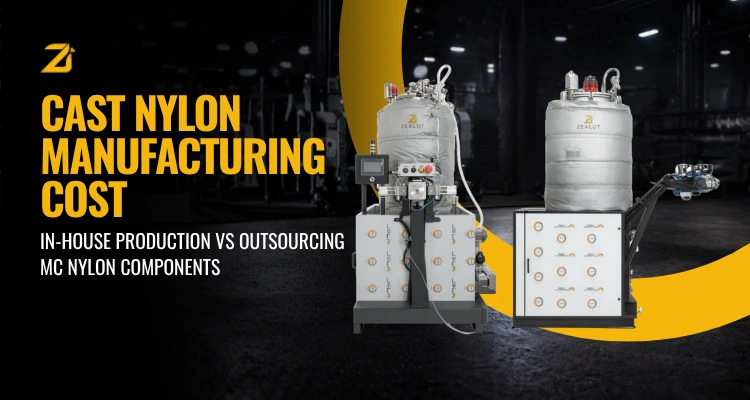
Zealot Inc. supplies nylon casting and dispensing systems for manufacturers considering bringing cast nylon production in-house.
Support can include application analysis, production review, machine specification and design, installation, commissioning, operator training and assistance after startup.
This approach connects the equipment configuration with the intended part family, material requirements, production capacity and process-control needs. Manufacturers that determine internal production is commercially suitable can establish greater ownership of the cast nylon manufacturing process.
Zealot Inc. is a Gandhinagar, Gujarat-based engineering company with experience in metering, mixing and dispensing systems. These systems help control material ratios, temperature, mixing and delivery during cast nylon production.
Conclusion
Choosing between in-house cast nylon production and outsourcing MC nylon components requires more than comparing equipment cost with a supplier quotation.
Annual volume, equipment utilization, supplier pricing, quality requirements, lead time and hidden costs all influence the break-even point. Neither route is automatically cheaper for every manufacturer or component.
Where recurring demand and operational capability support internal production, a technical review of the machine and part requirements should take place before capital is committed. When demand is low or variable, outsourcing to a qualified job-work supplier may remain the more practical option.
Frequently Asked Questions (FAQs)

Digvijaysingh Rao
Head of Sales & Strategy
Digvijaysingh Rao leads sales and business development at Zealot Inc. He works closely with customers to understand their production challenges and recommend solutions that are practical and easy to maintain.