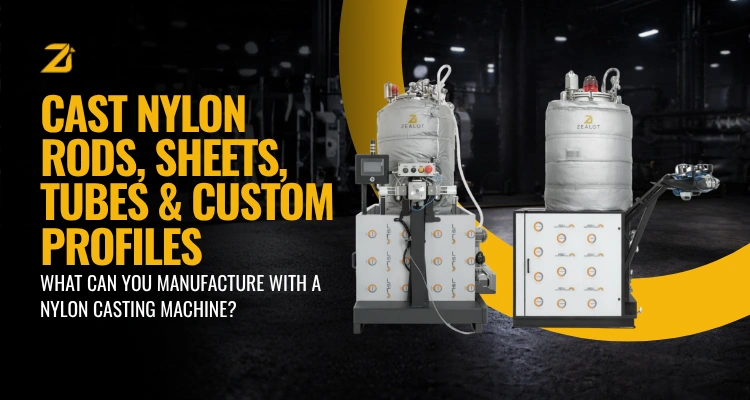
Cast Nylon Rods, Sheets, Tubes & Custom Profiles: What Can You Manufacture with a Nylon Casting Machine?
 Digvijaysingh Rao
on
Digvijaysingh Rao
on
Introduction
Most buyers picture cast nylon as one thing: a rod on a shelf, cut to length and machined into a bushing. A nylon casting machine can do far more than that. The same monomer-casting process that produces rod stock can also pour full sheets, cast hollow tubes without ever drilling a core hole, and grow a finished gear or sheave directly to its final shape in a single mold. Knowing which of these four forms fits a given part, and why changes both the cost and the lead time of the finished component.
This guide covers what a nylon casting machine actually produces: rods, sheets, tubes, and custom profiles, how each is cast, the size ranges to expect, and when custom profile casting beats buying stock shapes and machining them down.
Key Takeaways
- A single nylon casting machine can produce four distinct product forms: rods, sheets or blocks, tubes, and custom near-net-shape profiles.
- Rods and sheets are cast by static, gravity-fed pouring into open molds, the simplest and most common casting method.
- Tubes are cast by spinning the mold so centrifugal force forms the hollow wall, which avoids drilling a core hole through solid stock.
- Custom profiles are poured directly into a shaped mold, growing a near-final part such as a gear or sheave without machining it from a block.
- Cast nylon parts are essentially unlimited in size and thickness compared with extruded or injection-molded nylon, since the process is not constrained by clamping force.
- Buying stock rod or sheet and machining it makes sense for one-off parts; casting a custom profile makes sense once volume or part size makes machining wasteful.
- The same underlying chemistry, caprolactam polymerized with a catalyst and activator, produces all four forms, so material grade decisions carry across every shape.
Quick Answer: What Can a Nylon Casting Machine Produce?
| Product Form | Casting Method | Typical Size Range | Common Use |
| Rod | Static, gravity-fed vertical or horizontal mold | Roughly 10 mm to 500 mm diameter | Bushings, gears, rollers, machined blanks |
| Sheet or block | Static, open mold pour | Roughly 12 mm to 150 mm+ thickness, up to 1.2 m by 2.4 m sheets | Wear plates, liners, large machined components |
| Tube | Centrifugal casting, mold spun during pour | Roughly 50 mm to 900 mm outer diameter | Sleeve bearings, large bushings, wear liners |
| Custom profile | Shaped mold, part-specific cavity | Limited mainly by mold and tank capacity | Gears, sheaves, wheels, wear pads, custom fixtures |
How a Nylon Casting Machine Works
Every form starts the same way. Caprolactam monomer is mixed with a catalyst, typically sodium caprolactamate, and an activator, then heated to around 80 to 100°C to form a low-viscosity liquid. The liquid is dosed into a preheated mold, generally 140 to 160°C, where anionic polymerization converts it directly into solid nylon 6 inside the mold cavity. Because the part forms in place rather than being melted and pushed through a die or into a clamped cavity, there is no high-pressure injection step and comparatively low internal stress in the finished part.
What changes between rods, sheets, tubes, and custom profiles is the mold geometry and how the mold is handled during the pour, not the underlying chemistry. For the full breakdown of the anionic polymerization reaction itself, see How Cast Nylon Is Made: The Anionic Polymerization Process Explained Simply.
Cast Nylon Rods
Rod is the most common cast nylon product and the one most buyers already recognize. Rods are cast in vertical or horizontal cylindrical molds using straightforward static, gravity-fed pouring, which keeps the process simple and repeatable across long production runs.
Standard cast nylon rod typically runs from around 10 mm up to 500 mm in diameter, with larger custom diameters achievable on equipment built for oversized molds. Length is generally limited by mold height rather than the chemistry, so rod stock is commonly supplied in lengths from a few hundred millimeters up to several meters depending on diameter.
Rod is the starting material for turned and machined components: bushings, gear blanks, rollers, spacers, and thrust washers. Because cast nylon machines cleanly with carbide tooling and hold tighter tolerances than extruded rod after machining, it remains the default choice when a shop needs to turn a batch of round parts from stock.
Cast Nylon Sheets and Blocks
Sheet and block casting uses the same static pour into a flat or rectangular open mold. Because the process is not limited by injection pressure or clamp tonnage the way plastic injection molding is, cast nylon sheet can be produced in thicknesses and panel sizes that would be impractical to injection mold or extrude.
Typical sheet stock runs from around 12 mm (0.5 in) up to 150 mm (6 in) thick, with panel sizes commonly up to roughly 1.2 m by 2.4 m, and thicker blocks or oversized panels available through custom tooling. This makes sheet and block casting the practical route for large wear plates, chute liners, structural pads, and oversized components that get machined down from a single cast blank rather than assembled from smaller pieces.
Cast Nylon Tubes
Tube casting is where the process genuinely differs from rod and sheet work. Rather than drilling a bore through a solid rod, which wastes material and can introduce stress and eccentricity, tube casting spins the mold on its axis during the pour. Centrifugal force throws the liquid monomer outward against the mold wall, where it polymerizes into a hollow cylinder with a consistent wall thickness and no core pin required.
Cast nylon tube is typically available from around 50 mm up to 900 mm in outer diameter, with wall thickness set independently by controlling the volume of material dosed into the spinning mold, and length commonly up to around 1.2 m per pour. Because the wall forms under centrifugal pressure rather than by removing material, tube castings tend to show more consistent density through the wall section than a bored rod of the same size, which matters for large-bore sleeve bearings and heavy-duty bushings where uniform wear resistance around the full circumference is the point of specifying cast nylon in the first place.
Custom Profiles and Near-Net-Shape Castings
This is the capability that separates a nylon casting machine from a plastics distributor's stock shelf. Instead of buying rod or block and machining away most of the material to reach a finished shape, a mold can be built to the part's actual geometry, so the casting comes out close to its final form. A large gear, a sheave, a wheel hub, or a custom wear pad can be grown directly in the mold rather than turned and milled from solid stock.
Near-net-shape casting cuts material waste and machining time substantially on large or complex parts, since the bulk of the shape is already correct coming out of the mold and only finish machining, drilling, or bore work remains. It is also the only practical route for oversized or one-of-a-kind components, such as large sheaves or custom bearing housings, where no standard rod or block diameter is big enough to machine the part from in the first place.
Material Grades You Can Cast
The same casting process that produces standard natural nylon 6 also accepts additives mixed into the monomer before the pour, so grade selection is not limited to a single material regardless of which of the four forms is being cast.
Common cast nylon grades include unfilled natural nylon 6 for general-purpose components, oil-filled and molybdenum disulfide-filled grades for self-lubricating bearings and bushings, glass or mineral-reinforced grades for higher stiffness and load capacity, heat-stabilized grades for continuous service at elevated temperature, FDA-compliant food-grade formulations for processing and packaging equipment, and colored or UV-stabilized grades for outdoor and identification purposes. Because the additive is introduced during mixing rather than after the part is formed, grade selection applies equally whether the final product is a rod, a sheet, a tube, or a custom profile.
Choosing Rod, Sheet, Tube, or Custom Profile for Your Part
Need a round part machined from stock, such as a bushing or gear blank?
Rod is the standard starting material and the most cost-effective route for small to medium round components produced in low to moderate volume.
Need a flat wear surface, liner, or large machined block?
Sheet or block casting is the right form, particularly once thickness or panel size exceeds what injection-molded or extruded sheet can practically supply.
Need a large-bore bearing, bushing, or hollow cylindrical part?
Tube casting avoids the material waste and eccentricity risk of boring a hole through solid rod, and delivers more consistent wall density for wear applications.
Need a large, complex, or high-volume part such as a gear, sheave, or custom housing?
Custom profile casting is worth the mold investment once the part is too large to machine economically from standard stock, or once volume justifies a part-specific mold.
Stock Shapes vs Custom Casting: Which Should You Buy?
For a single prototype or a low-volume run of a standard round or flat part, buying stock rod or sheet and machining it remains the fastest and cheapest route, since no part-specific mold is required, and material is readily available. A custom-shaped mold for near-net-shape casting typically represents a larger upfront tooling investment, roughly comparable in scale to a compaction die for powder metallurgy tooling, but it pays back through lower material cost and shorter machining time per part once volume or part size crosses a threshold.
As a rule of thumb, stock shapes make sense when the finished part could reasonably be cut from a standard rod, sheet, or tube diameter without excessive waste. Custom profile casting starts making sense when the part is larger than any standard stock size, when the shape would require removing most of the stock material to reach final form, or when the same shape will be produced repeatedly at meaningful volume.
Common Mistakes When Specifying Cast Nylon Shapes
Machining a large part from rod when a custom profile would cast it directly
If a part's finished geometry is far smaller than the stock rod or block it has to be cut from, most of the purchased material ends up as scrap. A near-net-shape mold often costs less overall once material and machining time are accounted for.
Assuming tube means drilled rod
A bored rod and a centrifugally cast tube are not the same part. Boring removes material from the center of a solid casting, which can leave uneven wall density and residual stress near the bore; centrifugal casting forms the wall directly under consistent centrifugal pressure.
Specifying a standard grade where an application needs a filled grade
Unfilled cast nylon works well in many applications, but a self-lubricating bearing surface, a food-contact part, or a component running at sustained elevated temperature generally needs an oil-filled, FDA-compliant, or heat-stabilized grade specified at the casting stage, not added afterward.
Ignoring shrinkage and annealing in dimensional planning
Cast nylon parts are typically annealed after demolding to relieve internal stress and stabilize dimensions. Skipping or under-specifying this step on large or precision components risks dimensional drift after the part is put into service.
Why Manufacturers Invest in Their Own Nylon Casting Machine
Buying finished cast nylon parts or stock shapes works well at low volume. Once a manufacturer is consuming rod, sheet, or custom castings regularly, owning the casting equipment removes the lead time and per-order markup of an outside supplier and gives engineering direct control over grade formulation, mold design, and pour scheduling.
Zealot Inc. designs and builds precision-controlled Cast Nylon Solutions dispensing systems for manufacturers making this transition, engineered to hold consistent monomer-to-catalyst ratios and mold temperature across every pour, whether the output is standard rod stock or a custom-shaped near-net profile. The same engineering group also builds turnkey production plants, so a manufacturer moving from buying cast nylon to casting it in-house gets machine, mold design guidance, and commissioning support from a single partner rather than piecing the line together across vendors. Zealot brings the same dual-material engineering background to its cast polyurethane elastomer systems, for manufacturers evaluating both materials for the same application.
Frequently Asked Questions (FAQs)
Read More:
-
-
- Cast Nylon vs Injection-Moulded Nylon: Which Performs Better in High-Load Industrial Applications?
- Cast Nylon Applications in India: 8 Industries That Rely on MC Nylon Components for High Performance
- How Cast Nylon Is Made: The Anionic Polymerization Process Explained Simply
- What is Cast Nylon (MC Nylon)? Complete Guide for Manufacturers
-

Digvijaysingh Rao
Head of Sales & Strategy
Digvijaysingh Rao leads sales and business development at Zealot Inc. He works closely with customers to understand their production challenges and recommend solutions that are practical and easy to maintain.