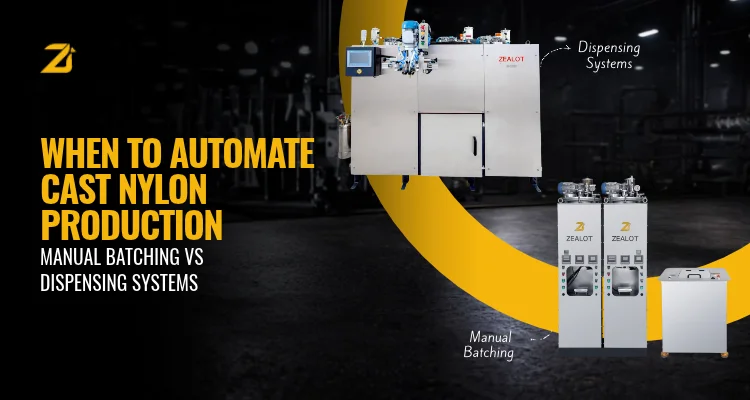
When to Automate Cast Nylon Production: Manual Batching vs Dispensing Systems
 Digvijaysingh Rao
on
Introduction
Manual batching can produce reliable cast nylon parts when materials, temperatures, and working practices are controlled. Automation becomes worth evaluating when repeat demand, avoidable losses, or a production constraint makes the existing process difficult to sustain.
For monomer-cast PA6, liquid caprolactam polymerizes inside the mold using a suitable catalyst and activator system. This differs from melting and reshaping finished nylon polymer. Moisture control, formulation preparation, and thermal history remain important whichever dispensing method is used.
Key Takeaways
- Evaluate the production problem before choosing an automation level.
- Separate dispensing controls from mold and cooling responsibilities.
- Verify component preparation as well as delivered quantities.
- Diagnose rejects before assuming automation will eliminate them.
- Compare achievable annual benefits with additional operating costs.
- Validate the proposed system using representative parts and materials.
What Manual Batching Means in Cast Nylon Production
Manual batching means operators measure, combine, and pour reactive preparations using manual or basic assisted equipment. Heating can still use automatic controllers. Manual pouring does not necessarily mean that operators adjust every temperature by hand.
This approach can suit prototypes, one-off castings, trials, and low or uncertain demand. It can also support repeat work when procedures, equipment, and inspection provide adequate control.
The limitations depend on the installation. Weighing errors, inconsistent timing, material exposure, or variable pouring can affect results. Handling hot reactive preparations also requires appropriate equipment, procedures, and operator protection. Assess actual performance rather than assuming all manual operations are unreliable.
What a Cast Nylon Dispensing System Controls
A dispensing system can heat, meter, mix, and deliver the reactive preparations within specified operating limits. Zealot's nylon systems provide a starting point for discussing equipment scope and application requirements.
Common arrangements use separate caprolactam/catalyst and caprolactam/activator preparations. Accurate delivery of these streams does not compensate for incorrectly prepared concentrations. Record both formulation preparation and metered delivery, with the ratio basis defined.
Confirm which temperatures the quoted system controls: tanks, lines, pumps, mixing head, or molds. A dispensing unit does not automatically control the reaction temperature throughout a filled mold or provide a complete cooling system.
Saved recipes support consistent settings, but delivered quantities and temperatures still need calibration and verification. Metering pumps must suit the actual fluid, temperature, pressure, and required minimum dose. Ask how component delivery is checked at representative operating points.
Manual Batching vs Dispensing Systems
| Factor | Manual batching | Dispensing system |
|---|---|---|
| Component delivery | Weighed or measured by operators | Metered within verified operating limits |
| Temperature | Depends on installed heating controls | Integrated controls where specified |
| Repeatability | Depends on procedures and equipment | Depends on calibration, preparation, and controls |
| Throughput | Constrained by the complete production cycle | Also constrained by the complete cycle |
| Changeovers | May be practical for small trial batches | Requires planned cleaning and preparation |
| Investment | Usually lower initial commitment | Higher installed cost and maintenance needs |
| Records | Manual or assisted logging | Automated records if included |
| Suitable work | Trials and appropriately controlled repeat work | Applications with demonstrated technical and economic benefit |
Assess the actual line bottleneck. Material preparation, replenishment, dispensing, available molds, polymerization, cooling, demolding, and downstream machining can all constrain output. Faster pouring adds little capacity if molds remain occupied for most of the shift.
Six Signs That Justify an Automation Review
These signs identify questions to investigate, rather than a fixed threshold for purchasing equipment:
- Repeat orders create predictable demand for a defined group of parts.
- Reject investigations identify avoidable dosing, mixing, or delivery variation.
- Large castings make each failed batch particularly expensive.
- Comparable parts show unexplained variation between operators or shifts.
- Dispensing is a measured bottleneck against confirmed customer demand.
- Customers require traceability or process records that are difficult to maintain.
A single substantial issue may justify a review. Several small issues do not automatically justify a machine. Establish the cost, cause, and achievable improvement for each concern.
Track rejected castings by part, formulation batch, shift, defect, and process conditions. Voids, brittle areas, and inconsistent hardness can have several causes, including material condition and thermal history. They are not proof that dispensing equipment is the missing solution.
When Manual Batching Still Makes Sense
Retain manual batching when it meets quality and delivery requirements economically. It may remain appropriate for changing designs, experimental formulations, intermittent demand, or parts whose preparation and cooling dominate the cycle.
Before adding equipment, establish a reliable baseline:
- Follow the formulation supplier's moisture limits and handling instructions.
- Verify component preparation, weighing equipment, and batch identification.
- Record relevant feed and mold temperatures, mixing, and filling times.
- Compare inspection results under consistent measurement conditions.
Dry raw materials are necessary for anionic polymerization, but sealed storage alone does not prove acceptable moisture content. Specify appropriate checks and approved dry handling or drying provisions. Use the chemistry guide to support the process discussion, then confirm instructions with the material supplier.
Calculate the Financial Case Correctly
Keep initial investment separate from recurring annual costs. Do not compare one year's scrap expense directly with a list containing the full purchase price and annual maintenance. Use a consistent currency and time basis.
Initial installed investment includes equipment, installation, commissioning, initial training, and qualification. Include required modifications to utilities, material handling, and the production area.
Net annual benefit equals achievable scrap and rework savings, plus realizable labor savings and contribution from additional saleable output, minus additional annual operating costs. Include maintenance, spares, utilities, consumables, cleaning, and expected downtime in those operating costs.
Simple payback in years equals initial installed investment divided by net annual benefit. This calculation requires a positive annual benefit. NIST's investment guidance also describes discounted cash-flow methods for a more complete assessment.
For example, an installed investment of ₹30 lakh with a verified net benefit of ₹10 lakh per year has a simple payback of three years. This hypothetical example excludes financing and discounted cash-flow effects; it is not a machine-price or savings estimate.
Do not assume all existing rejects disappear. Avoid counting the same casting under both scrap and rework savings. Released operator hours become a financial benefit only when they reduce costs or support useful additional work. Extra capacity has value only where demand and downstream capacity support sales.
Test conservative, expected, and higher-demand scenarios. Compare buying equipment with improving the manual process or outsourcing selected work. Zealot's cost guide explores the in-house production and outsourcing decision.
What Dispensing Automation Does Not Fix
Correct dosing cannot rescue contaminated inputs or an unsuitable thermal cycle. Material quality, formulation concentrations, mold preparation, and part geometry remain part of the process.
For thick or heavy castings, validate polymerization and cooling through the section. Heat generation, temperature gradients, crystallization, and residual stresses require attention. The right thermal schedule depends on the formulation and geometry, rather than the dispensing label alone.
Mold cleaning, heating, handling, and appropriate venting remain necessary. These tasks may be manual or automated depending on the installation. Define responsibilities rather than assuming every dispensing package includes them.
Inspection also remains necessary. Specify dimensional measurement temperature and moisture condition because nylon can change dimensions as it absorbs or releases water. Agree visual, dimensional, and application-specific material checks, including any post-casting treatment required for acceptance.
Introduce Automation in Practical Stages
A phased approach can limit capital exposure, but a semi-automatic installation is not mandatory for every project. Select the sequence that fits the proven need:
1. Stabilize material handling, preparation, weighing, and temperature records.
2. Identify repeat parts and establish reject and cycle-time baselines.
3. Trial the proposed dispensing arrangement with representative formulations.
4. Measure quality, labor, output, changeover time, and material losses.
5. Confirm interfaces, upgrade options, and responsibilities before purchase.
6. Commission the installation and verify performance under agreed site conditions.
For integrated installations, Zealot's turnkey services can be discussed alongside equipment, layout, commissioning, and training. Ask which functions can be expanded later; upgrades may require new hardware, controls, or qualification.
What to Prepare for a Supplier Review
Provide enough information to assess the complete production sequence:
- Part drawings, finished weights, and proposed casting quantities.
- Grade, formulation details, and current technical and safety data sheets.
- Demand, shift pattern, current cycle times, and expected growth.
- Mold numbers, sizes, heating arrangements, and handling requirements.
- Reject causes, rates, rework, and current inspection methods.
- Storage, moisture controls, preparation, and changeover procedures.
- Available space, utilities, extraction, and integration requirements.
- Acceptance criteria, traceability needs, and trial responsibilities.
Define how delivered ratio, shot quantity, temperature stability, and restart behavior will be demonstrated. Request representative trials with written acceptance limits. Saved recipes and an equipment demonstration alone do not establish production capability.
Why Consider Zealot Inc
Zealot Inc., based in Gandhinagar, Gujarat, offers cast nylon equipment and related dosing solutions. Its published approach includes application consultation, equipment design, installation, training, and ongoing support.
Confirm what the proposed package controls, what the plant must provide, and how performance will be accepted.
Conclusion
Automate cast nylon production when a demonstrated process improvement supports quality, delivery, or a sound financial case. Stabilize manual practice first where practical, diagnose losses, and validate the proposed equipment against representative work.
Compare initial investment with realistic annual benefits, and include the complete line in the decision. The best installation addresses the actual constraint and has clear responsibilities for materials, molds, inspection, and maintenance.
Frequently Asked Questions (FAQs)
Read More:
- Cast Nylon vs Injection-Moulded Nylon: Which Performs Better in High-Load Industrial Applications?
- Cast Nylon Applications in India: 8 Industries That Rely on MC Nylon Components for High Performance
- Cast Nylon Rods, Sheets, Tubes & Custom Profiles: What Can You Manufacture with a Nylon Casting Machine?

Digvijaysingh Rao
Head of Sales & Strategy
Digvijaysingh Rao leads sales and business development at Zealot Inc. He works closely with customers to understand their production challenges and recommend solutions that are practical and easy to maintain.