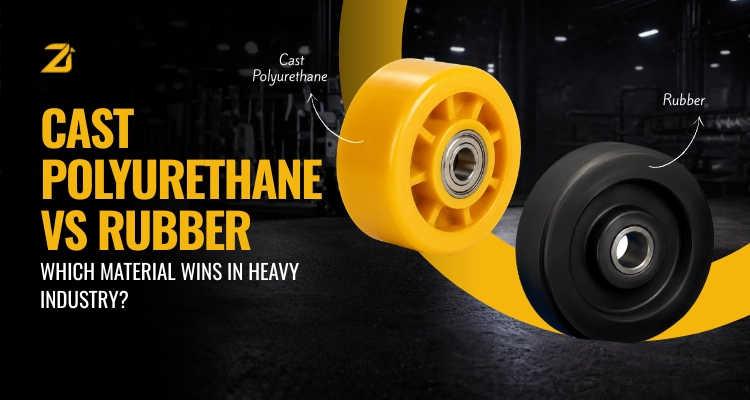
Cast Polyurethane vs Rubber: Which Material Wins in Heavy Industry?
 Digvijaysingh Rao
on
Digvijaysingh Rao
on
Introduction
Which material performs best in heavy industry - polyurethane or rubber? For plant managers and procurement heads, this isn’t just a technical question; it is a high-stakes financial decision. Selecting the wrong material for a conveyor roller, an industrial wheel, or a high-wear liner can lead to catastrophic downtime and ballooning maintenance costs.
The reality is that "the best" material is entirely dependent on your specific operational environment. The choice hinges on critical factors: abrasion resistance, load-bearing capacity, noise and vibration damping, and the total cost of ownership (TCO).
At Zealot Inc., we have spent decades navigating these trade-offs. We began manufacturing premium polyurethane wheels in 1996. Since then, we have worked closely with Indian and international manufacturers to replace failing rubber components with precision-engineered polyurethane elastomer solutions that extend equipment life by up to four times.
Key Takeaways
- Polyurethane outperforms rubber in nearly every wear-related metric, offering significantly higher abrasion and tear resistance.
- Cast PU vs. Rubber Rollers: Polyurethane provides a non-marking, oil-resistant surface that outlasts rubber in high-speed industrial applications.
- Lifecycle Cost Reduction: While PU often has a higher initial price, its durability reduces maintenance frequency and production downtime.
- Performance Range: Zealot’s PU elastomers offer 60-90 Shore A hardness and 200–500% elongation, maintaining shape under loads that would deform rubber.
- Chemical Resistance: Polyurethane is naturally inert to many corrosive agents and oils that cause rubber to swell or degrade.
The Two Materials Indian Manufacturers Compare Most
In the modern industrial landscape, especially within India’s growing manufacturing hubs like Gujarat and Maharashtra, two materials dominate the wear-part conversation:
- Cast Polyurethane Elastomer: A high-performance material that combines the flexibility of rubber with extreme durability. It is known for its high load-bearing capacity and exceptional resistance to chemicals and oils.
- Industrial Rubber: The traditional choice for seals, gaskets, and low-cost damping. While versatile, rubber is prone to "chunking," UV degradation, and rapid wear in abrasive environments.
Polyurethane vs Rubber - Head-to-Head Comparison
For many, the polyurethane elastomer vs rubber debate is the most common dilemma. While they look similar, their molecular structures lead to vastly different performance outcomes.
Material Performance Table
| Parameter | Cast Polyurethane (PU) | Industrial Rubber | Industrial Impact |
|---|---|---|---|
| Abrasion Resistance | Excellent (Highest) | Moderate to Low | PU significantly extends component life in high-wear environments. |
| Load-Bearing Capacity | High | Low to Moderate | PU maintains shape under heavy loads, reducing deformation and failure. |
| Tear Resistance | Superior | Prone to Cracking | PU reduces unexpected breakdowns and improves operational reliability. |
| Chemical & Oil Resistance | Excellent | Poor (Swelling/Degradation) | PU performs consistently in oily and chemical-heavy industrial environments. |
| Service Life | 3x to 5x Longer | Short | PU lowers maintenance frequency and total cost of ownership over time. |
Why PU Wins in High-Wear Applications
In a cast PU vs. rubber rollers comparison, polyurethane consistently wins because of its superior surface chemistry. Rubber tends to "set" or permanently deform under load (compression set), whereas Zealot’s PU elastomers maintain their shape while offering 200–500% elongation. This makes PU the definitive winner for scraper blades, conveyor liners, and heavy-duty wheels.
Weight and Energy Efficiency
Polyurethane is significantly lighter than many reinforced rubber compounds. Replacing heavy rubber-clad wheels with high-performance PU wheels reduces the energy required for propulsion and minimizes strain on drive motors in automated systems.Surface and Product Protection
In material handling, rubber can often leave black carbon marks on finished goods. Polyurethane is non-marking, protecting finished products such as coated steel sheets or delicate automotive components from surface contamination and scratches.When Rubber Still Wins
Technical authority requires recognizing the specific strengths of all materials. Rubber remains superior in niche applications:
- Extreme Vibration Damping: For ultra-sensitive machinery where isolation is more important than wear resistance, certain natural rubber compounds offer better high-frequency damping.
- Ultra-Low-Temperature Environments: While PU performs well at -40°C, some specialized rubbers can remain flexible at even lower temperatures.
- Low-Cost Commodity Applications: If a part is non-critical, easily replaceable, and operates in a dry, low-stress environment, rubber’s lower upfront cost may be justified.
Total Cost of Ownership: The Metric That Matters
Indian procurement teams often make the mistake of looking at the "Unit Price" rather than the Total Cost of Ownership (TCO).
Consider this scenario:
- Standard Rubber Roller: Cost ₹10,000. Lasts 6 months. Downtime for replacement: 4 hours.
- Zealot Polyurethane Roller: Cost ₹25,000. Lasts 24 months. Downtime for replacement: 4 hours (once every 2 years).
Over two years, the rubber option costs ₹40,000 in parts alone, plus the cost of 16 hours of lost production. The PU option costs ₹25,000 and only 4 hours of downtime. Despite being 2.5x more expensive upfront, the polyurethane solution is the more profitable choice for the plant.
Zealot's Take: Observations from Indian Plants
Many Indian factories continue to use rubber because "that's what we've always used." However, since 1996, our engineering team has seen that 80% of rubber failures in material handling are due to oil contamination or abrasion—two areas where our cast polyurethane excels.
Our experience with MDI and TDI casting systems allows us to customize the hardness of the material (from 60-90 Shore A) to the exact needs of the plant. We have helped clients replace failing rubber liners with PU versions not just to extend life, but to eliminate the "chunking" that was causing high rejection rates in their quality control labs.
Conclusion
There is no universally "best" material - only the best material for your specific industrial conditions.
- Choose Polyurethane when you need maximum abrasion resistance, high load-bearing capacity, and oil/chemical resistance. It is the gold standard for industrial rollers, wheels, and wear-liners.
- Choose Rubber for low-cost, non-critical seals or extreme high-vibration damping.
At Zealot Inc., we aren't just selling parts; we are providing an engineering partnership. With over 30 years of manufacturing expertise, we ensure you get the right material for the right job.
Frequently Asked Questions (FAQs)
Read More:
- What is Polyurethane Dispensing and How Does It Work
- What is Metal Injection Molding (MIM)? Complete Beginner’s Guide
- What is Cast Nylon (MC Nylon)? Complete Guide for Manufacturers
- What is Polyurethane Dispensing and How Does It Work
- How the Polyurethane Casting Process Works: Step-by-Step for Manufacturers

Digvijaysingh Rao
Head of Sales & Strategy
Digvijaysingh Rao leads sales and business development at Zealot Inc. He works closely with customers to understand their production challenges and recommend solutions that are practical and easy to maintain.