
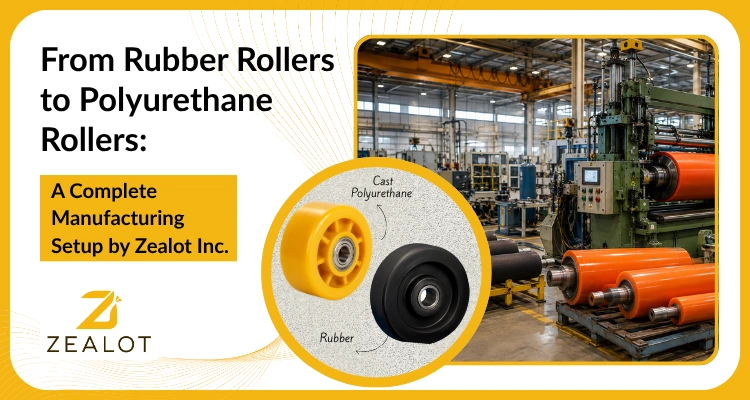
The Context
How a Rubber Roller Manufacturer Built a Complete Polyurethane Roller Production Line
Rubber roller manufacturing and polyurethane roller manufacturing are not the same process with different materials. They are fundamentally different technologies, and manufacturers who attempt the switch without process-level support rarely get it right on the first attempt.
This case study documents how an established rubber roller manufacturer in India successfully transitioned into polyurethane roller production — not by purchasing a machine and figuring out the rest independently, but by partnering with Zealot Inc. for a complete, integrated solution.
About the Customer
The client was a well-established rubber roller manufacturer with years of experience in machining, roller finishing, and quality control. They had existing infrastructure, a skilled workforce, and an active customer base.
The decision to add polyurethane rollers to their product portfolio was strategic. Their industrial clients were asking for PU rollers due to better abrasion resistance, longer service life, and lower maintenance frequency compared to rubber. Rather than lose that business to competitors already offering PU rollers, the company decided to build the capability in-house.
What they needed was not just equipment. They needed the knowledge, the tooling, and the process to produce consistent, high-quality polyurethane rollers at commercial scale.
Core Challenge
Why the Rubber-to-Polyurethane Shift Is Technically Demanding
Polyurethane roller production is a precision casting process. Every stage from mould preheating to raw material metering, mixing, pouring, and curing must be executed within tight parameters. Deviations that would be manageable in rubber processing can cause surface defects, voids, hardness inconsistencies, or complete batch rejection in polyurethane.
The customer recognized this gap early. They understood that buying a casting machine without the surrounding process knowledge correct mould design, oven specifications, material ratios, curing cycles, demoulding technique would lead to costly trial-and-error.
Specifically, they needed
- 01 A PU elastomer casting machine matched to their roller size range and production volumes
- 02 Preheating and curing ovens designed for polyurethane processing temperatures
- 03 Roller moulds engineered to their exact dimensional specifications
- 04 Raw material handling guidance covering mixing ratios and processing temperatures
- 05 On-site commissioning support and operator training
- 06 Continued technical involvement until the first roller was produced independently
The Zealot Inc. Approach
Engineered around one customer, not shipped from a catalogue.
Zealot began with a detailed technical assessment of the customer's requirements before any equipment was specified. The team reviewed roller dimensions, load specifications, planned production volumes, material preferences, and existing factory infrastructure.
This assessment shaped every decision that followed machine capacity, oven dimensions, mould design, and the training plan. Nothing was standardized and shipped. Everything was engineered around what this specific customer needed to produce successfully.
The Solution
Solution Implementation
From Challenge to Results
Results & Outcomes
Line Operational On Schedule

Operator Independence

Single-Partner Sourcing

Faster Production Stability

In-House Technical Depth

Support After Handover
Takeaways for Manufacturers
Key Takeaways
The Bottom Line
Conclusion
The shift from rubber roller production to polyurethane roller manufacturing is a significant technical step. The materials behave differently, the process demands tighter control, and the equipment must be matched to the specific requirements of the part being produced.
What this case study demonstrates is that the transition is entirely achievable when approached systematically with proper engineering, process-matched tooling, and hands-on knowledge transfer from a team that has built these systems before.
Zealot Inc.'s role in this project was not to sell a machine and move on. It was to ensure that the customer could produce polyurethane rollers reliably and independently, with the technical foundation to grow that capability over time.