
Pressure Tanks for Seamless Material Dispensing
Engineered for consistent pressure, precise flow, and uninterrupted production.
What is a Pressure Tank?
A pressure tank is a sealed, reinforced vessel designed to hold liquid under compressed air or gas pressure. Unlike an open container, the tank is fully closed and pressurised — when an outlet valve is opened, the air pressure above the liquid forces it out in a smooth, controlled flow without the need for any pump.
The working principle is straightforward:
- Fill the tank with the required liquid and close the lid securely
- Connect compressed air to the inlet and set the regulator to the required pressure
- Air pressure builds above the liquid surface inside the sealed tank
- Open the outlet valve — the liquid flows out steadily at the set pressure
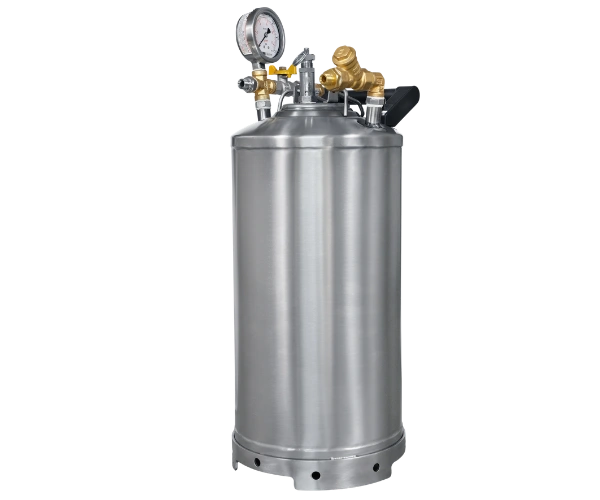
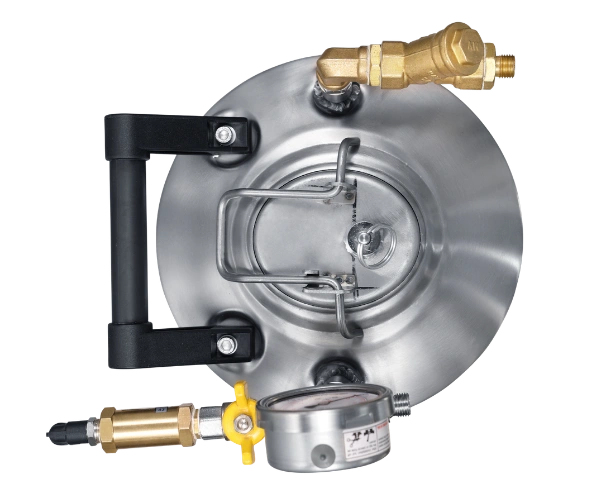
Key advantages of pressure delivery over a pump:
- No moving parts contact the fluid — zero contamination risk
- Smooth, pulse-free flow — critical for accurate dispensing and uniform spray
- Easy to clean, refill, and change between different fluids
- Simple operation — only a compressed air supply is needed
Countries Served
Years of Experience
Complete Consultation
Machines Delivered
Technical Specifications
| Specification | Detail |
|---|---|
| Tank capacity | 20 Litres |
| Body material | Stainless Steel 304 |
| Fitting material | Brass |
| Max. working pressure | 6 bar (87 psi) |
| Typical working range | 2 – 4 bar for solvent / cleaning use |
| Lid type | Quick-release wire bail clamp |
| Handle | Ergonomic, side-mounted |
| Fluid connection | 1/4" BSP outlet valve |
| Air inlet | Push-fit quick-connect nipple |
| Safety relief valve | Brass, preset at 6 bar |
| Pressure gauge | Dial type, top-mounted on lid |
| Vent valve | Yellow butterfly valve — manual depressurise |
Primary Use — PU Machine Mixing Chamber Cleaning
In polyurethane (PU) foam and elastomer machines, two reactive chemicals — polyol and isocyanate — are combined inside a mixing head. After each production shot, residual material inside the mixing chamber must be flushed out immediately with solvent. If not cleaned, the material cures and permanently blocks the mixing head. The pressure tank delivers this solvent quickly, reliably, and at a controlled pressure.
| Parameter | Detail |
|---|---|
| Fluid filled | Cleaning solvent (MEK, acetone, or machine-specific) |
| Operating pressure | 2 – 4 bar (set on air regulator) |
| Outlet connection | Hose from outlet valve → solvent inlet of PU machine |
| Cleaning sequence | Open valve → solvent flushes mixing head → close valve → vent |
| Refill procedure | Vent → open lid clamp → fill → close lid → pressurise |
| Max. fill level | Do not exceed 80% capacity (16 L max) — air space required |
Applications — Where Pressure Tanks Are Used
| Application | How the pressure tank is used |
|---|---|
| PU mixing chamber cleaning | Delivers solvent under air pressure to flush mixing head after each shot |
| Resin & adhesive dispensing | Pushes low-viscosity resin to a nozzle — no pump, no pulsing |
| Paint & coating supply | Feeds pressure-pot spray systems for uniform atomisation |
| Mould release agent delivery | Stores and sprays release agents for foam or composite moulds |
| Pigment & colour dosing | Dispenses tints into mixing systems at controlled, repeatable pressure |
| Chemical line flushing | Pushes solvent or water through hoses and valves between fluid changes |
| Catalyst & additive delivery | Supplies precise volumes of catalyst or additive at steady pressure |
| Spray lubrication | Delivers lubricants or oils to moulds or machinery via spray nozzle |
Safety Instructions
WARNING: Always depressurise completely before opening the lid. Open the yellow vent valve and confirm the pressure gauge reads zero before removing the lid clamp. Never force the lid open under pressure — serious injury can result.
| Item | Instruction |
|---|---|
| Before opening lid | Open yellow vent valve — confirm gauge reads ZERO before removing lid clamp |
| Before filling | Vent fully → inspect lid gasket for cracks or solvent swelling |
| Max. fill level | Do not fill above 80% capacity (16 L) — air space is essential |
| Safety relief valve | Test every 3 months — must auto-vent at 6 bar or below |
| Pressure gauge | Replace if needle sticks or does not return to zero after venting |
| Solvent compatibility | Confirm fluid is compatible with SS 304 and brass before use |
| Storage | Store depressurised, lid open, in a ventilated area when not in use |
| Hose & fitting check | Inspect for leaks under low pressure before each production run |
Comparison with Beer Kegs
A pressure tank operates on the same fundamental principle as a beer keg: compressed gas sits above the liquid and pushes it out through an outlet. Both vessels are made from stainless steel 304 and are rated to similar pressures.
| Feature | Pressure Tank | Beer Keg |
|---|---|---|
| Working Principle | Compressed air pushes liquid out through an outlet | CO₂ gas pushes beverage out through a spear valve |
| Material | Stainless Steel 304 | Stainless Steel 304 |
| Design & Access | Removable, openable lid for easy filling and cleaning | Sealed body with only a central spear valve |
| Gas Used | Compressed air | Food-grade CO₂ to prevent oxidation |
| Pressure Rating | Up to 6 bar (higher working pressure) | Typically 0.8–2.5 bar |
| Application | Solvents, resins, industrial fluids | Food-grade beverages only |
| Chemical Compatibility | Can handle aggressive chemicals | Not suitable for chemicals |