
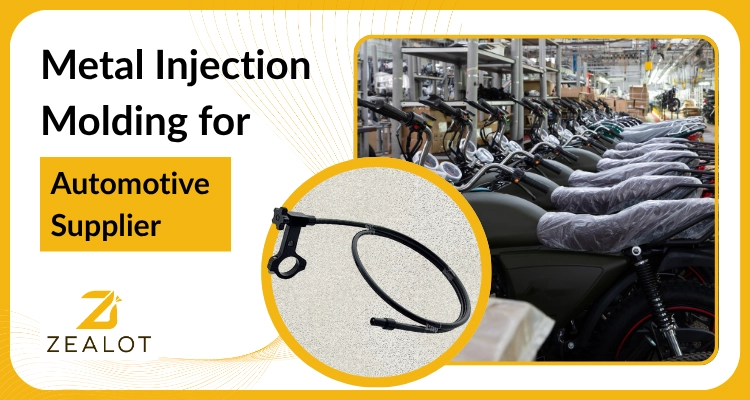
| Industry | Automotive — Two-Wheeler / Motorcycle Manufacturing |
|---|---|
| Component | Brake Lever Reach Adjuster |
| Client Profile | Tier-1 Automotive Supplier to OEM Assembly Lines |
| Technology Applied | Metal Injection Molding (MIM) — Low-Alloy Steel |
| Previous Process | Conventional CNC Machining |
| Outcome | High-volume daily output, significant per-unit cost reduction, near-zero rejections |
| Confidentiality | Client and OEM identities withheld per NDA. Results based on actual project data. |
The Problem
The Problem No One Talks About in Brake Component Manufacturing
Every motorcycle rider trusts their brakes. But few think about the small metal adjuster that lets them position the brake lever at exactly the right distance from the handlebar — the reach adjuster. For riders of different hand sizes, this isn't comfort engineering. It's a safety function.
For a well-established Tier-1 automotive supplier delivering this component to OEM assembly lines across India's two-wheeler market, the reach adjuster had become something unexpected: a production liability.
The part was being machined conventionally. And as motorcycle OEM demand accelerated — driven by expanding model variants across commuter, sport, and premium segments — the limitations of CNC machining were compounding into a genuine business problem.
The Core Question the Client Brought to Us:
"We know MIM exists, but we've never applied it to this category. Can it really handle a brake component — one that goes into a safety-critical assembly on high-volume OEM lines — with the precision, cost, and throughput we need?"
Core Challenges
The Core Challenge: Three Compounding Problems
What the client faced wasn't a single isolated issue. It was three interconnected manufacturing problems, each amplifying the others.

CNC Throughput Could Not Keep Pace with OEM Demand

Per-Unit Cost Was Incompatible with OEM Pricing Expectations

Geometric Complexity Was Generating Inconsistency and Rejections
The Solution Logic
Why Metal Injection Molding Is Built for Components Like This
Metal Injection Molding (MIM) combines the design freedom of plastic injection molding with the structural integrity of fully dense sintered metal. The process produces near-net-shape components — meaning the final part geometry is formed directly in the mold, with minimal or no secondary machining required.
For the brake lever reach adjuster specifically, MIM offered a precise match to the problem:
- Single-cycle geometry: The part's adjustment slots, contoured surfaces, and precision hole features could all be formed in a single molding cycle replacing multiple CNC setups with one controlled operation
- Near-zero material waste: MIM uses only the feedstock material needed to form the part. Material utilization is dramatically higher than billet machining, which discards significant metal as chips
- Process repeatability at scale: Once the mold tool is qualified, every part produced is a replica of the last. Part-to-part variation is controlled by the tool and process parameters, not by operator skill or setup variability
- Throughput advantage: MIM cycle times are far shorter per part than multi-setup CNC operations. A single qualified tool can produce high daily volumes, and additional tools can be added if capacity needs to grow
Our Solution
Our Solution: From Feasibility to Full-Scale MIM Production
The client's engineering team had not previously applied MIM to brake components. They came to us not just for a price quote, but for a manufacturing partner who could assess feasibility, develop the tooling, validate the part, and deliver at production scale. We structured our engagement in four stages.
From Challenge to Results
Results & Outcomes
The shift from CNC machining to MIM delivered measurable improvements across every dimension the client cared about. Here is what changed.

Output: Thousands of Parts Per Day

Quality Consistency: Near-Zero Rejections

Cost Per Part: Substantially Reduced

Safety Confidence: A Validated, Traceable Process
Takeaways for Automotive Suppliers
Key Takeaways for Automotive Component Manufacturers
The Bottom Line
Conclusion: Manufacturing Intelligence, Not Just Manufacturing Capacity
The brake lever reach adjuster is exactly the kind of component MIM was engineered for: small, geometrically intricate, mechanically demanding, and required in volumes that expose every inefficiency in a conventional machining process.
What was a production bottleneck for our client is now one of their most efficiently manufactured components — flowing reliably into the assembly lines of well-known motorcycle OEM brands, at a cost structure that works, with a quality record that strengthens their supplier position.
Our contribution went beyond quoting a price per piece. We brought engineering expertise in feasibility analysis, tool design, material selection, process validation, and quality assurance — making the transition from CNC to MIM fast, controlled, and commercially impactful.
That is what a genuine manufacturing partnership looks like.
Is Your Component a Candidate for MIM?
If you manufacture small-to-medium metal components with complex geometry, tight tolerances, or high-volume requirements — and your current process is creating cost pressure, throughput limitations, or quality variability — we would like to evaluate your component. Reach out to the Zealot Inc. engineering team to begin a no-obligation feasibility discussion.
Engineering Consultation
Ready to Evaluate Your Component for MIM?
Reach out to the Zealot Inc. engineering team to begin a no-obligation feasibility discussion. We assess geometry, mechanical requirements, tolerances, and production volumes to determine MIM suitability — typically within 5–7 business days.